
These Outdoor Kitchen Layout Ideas Work Flawlessly—An Architect Explains
You see, that outdoor kitchen is simply, “Yeah, I’m pretty good,” but not, you know, so much so that you can quite put into words. You don’t even need to step inside the room to feel a sense of zen-like equilibrium. The room is simply waving hello in your face as you pass by. The flow? Improvisational, as if it had your mind on its way. The design? Unflappable. It just. where it’s supposed to be, not having a tantrum or anything because it just so happened to be noticed. And lo, and behold. That’s no accident.
You know, grand great design is like that one grand great person who doesn’t have the words in their mouth. It’s there. But you get even a whiff of it, you’re done for, because you can’t help but see how totally masterfully to the letter it was executed.
From digital serenity of balance way down in the prep station to the way bar island anchors the whole enchilada, this place nailed it in the details category. And trust us? That initial impression is the very same reason people hang out. So, before that first of those burgers even has a right to rise up on top of that grill, let’s keep going with the search on why this floor plan is worthy of a bonafide A.
Orientation & Circulation—How Movement Flows Naturally

Good exterior kitchen design has less to do with treating oneself to high-roller “put the thing there.” No, it’s all about how precisely you, dear human, are able to move about in it. Orientation and circulation are the metaphorical bouncers of intelligent space planning—determining whether your party crew knows where to make a break for it next or whether they’re leaving their grill smoke addiction behind to regrill the dining area with a cloud-herringbone smoky treatment. The holy grail? Movement so silky smooth you’ll be moving involuntarily.
It’s an oversized game of chess with a ballet, so let’s begin with some careful staging: grill away from prevailing wind (or eye-ball for smoky flavors), prep station in the lines’ reach, and having the important ingredients within one pivot distance. And then circulation’s turn: no face-plunking into strangers (clear line of sight), a hopscotch-free hall, and rooms that are sufficiently well-separated so the human traffic jam hell does not ensue. When these two exist in harmony, the room seems to have magically grown, not having been cobbled together by a convention of chairpersons of committees.
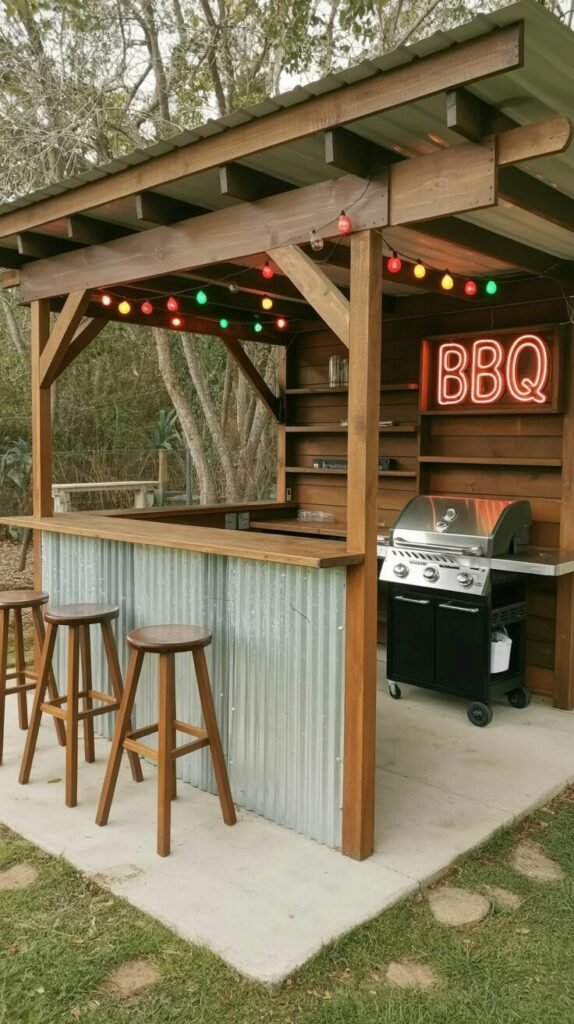
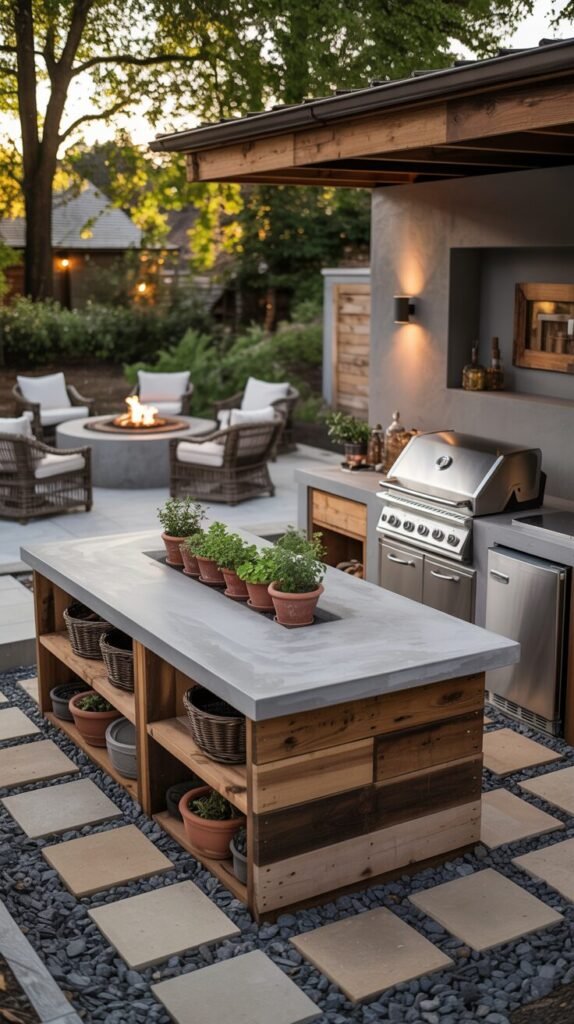
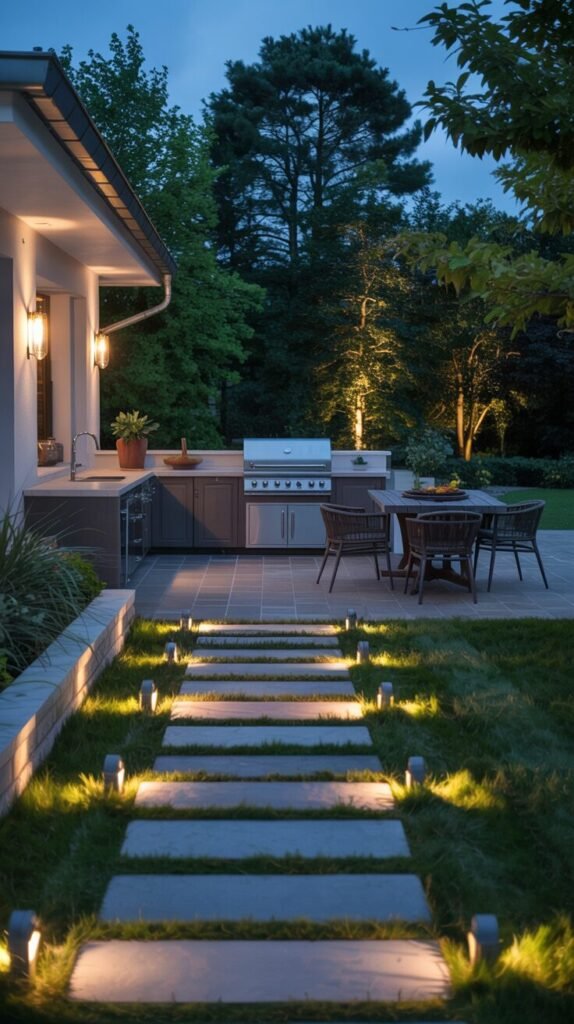
In our version of our initial photograph (the suspiciously pro-sounding one), the kitchen is really pretty neat alongside the dwelling. There is a scent, come on close sensual, of an introduction to a firepit lounge so cozy you can be coaxed nearly to be invited to stay awhile. The bar island is literally the hot bouncer between party and kitchen area so you can’t just be moseying back “excuse me, pardon me.”
You can just envision a host spilling drinks flirting flirtatiously with friends simultaneously behind the counter. That stumbling paver? They’re muffleding on like saying, “This way, please!” while the string lights above are really a visual high-five between areas. It’s party atmosphere with never once having to suffer the sardine-can claustrophobia.
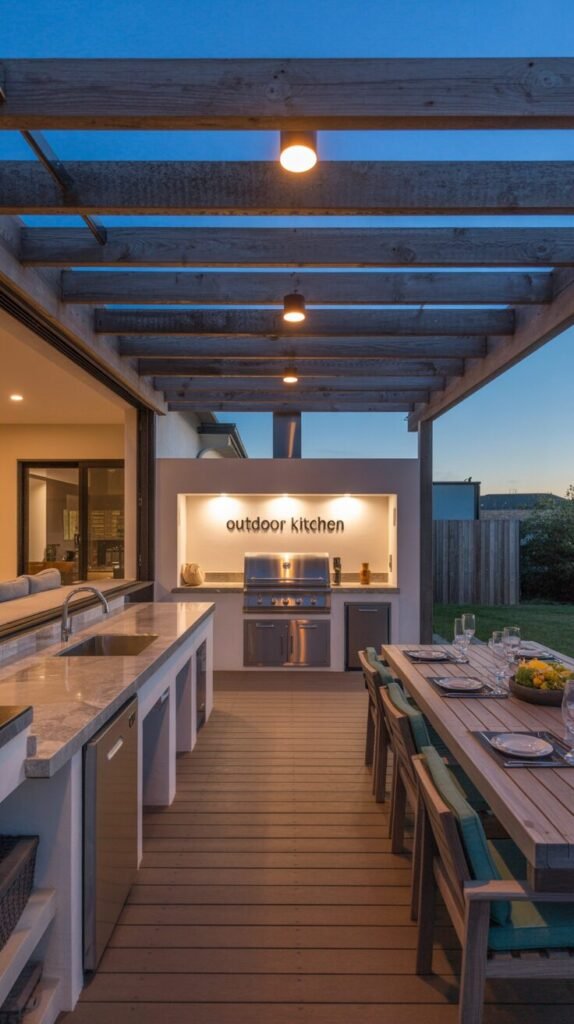
Swift’s rectangular shape, bless its pragmatist heart, is a masterclass in leaving room for air by placing the dirty staples—grill, sink, and dinner—along one line. Its secret ingredient? One-way workflow. From chopping veggies to putting down food on one line, it steers clear of cross-traffic fender benders.
The dining table lives just short of the “hot zone,” taking feral guest singeing but close enough to make serving easy. And that pergola? A technically giant pointing arrow, leveraging airflow and the feeling you’re going in the right direction, its overhead beams duplicating decking lines below as an elegantly dressed echo.

Oh, U-shaped kitchen. This one’s really a master of perimeter circulation. Each location—sink, grill, and counter—is its own anchor that holds up a ginormous big middle nothing area where you can spin around like free agent dance without bump. Sink, the sneak attack sink, pushes itself into corner so risk of foot-traffic knot on adjacent hotspots is removed.
No wonder the orientation is so welcoming; the doorway almost smiles into the dining lawn, encouraging you to slide easily into the seating area. At least even those stepping stones you’re treading on aren’t make-believe; they’re pushing you gently along the soft grass and reminding you kindly that you’re transitioning from “serious cooking” to “casual lounging.”
Style tip: Circulation starts from the door. Always consider how someone enters the space and what their first three steps will be—this is where orientation meets experience.
Zoning Without Walls—How This Space Separates Function Without Clutter
Outdoor kitchens are all about that wonderful, unrestored openness—but if you don’t have some kind of structure, that openness is raw, unadulterated chaos. The sorcerer’s trick? Zoning in space: deliberately putting things where they will affect the way you’ll use the space, without having to construct physical walls. The truly great architects form these virtual boundaries through cleverly piling up soft variations in floor, level, line of sight, and light. They are tricking your eye.
Think of it as a choreographed party dance—each zone (dining, prep, cooking, lounging) is allowed to have its own little personality but still be part of the same amazing party. Less about rigid symmetry here; more about establishing a natural rhythm for the flow of people moving through, talking, and just being in the space. Great zoning is an eye-only clutter wizard, makes all the pieces work more smoothly, and even tame small backyards into appearing like a consciously tiered work of art.
In the first shot (the one with the almost unnervingly impeccable setup), zoning is achieved in design and through thoughtful material transition. That grill wall is literally yelling, “This is where the magic happens!” and that concrete island—with its little herb spa—is coolly defining a separate prep area.
But the brilliance is not in what is present, but in what is absent. The pavers and gravel are really more of an open invitation to movement rather than confining anyone. And above it all, the seating area in front of the firepit is low and cushy and tastefully lined with trees—a quiet suggestion of its shared use, no partition required. Why enclose when you can tree?
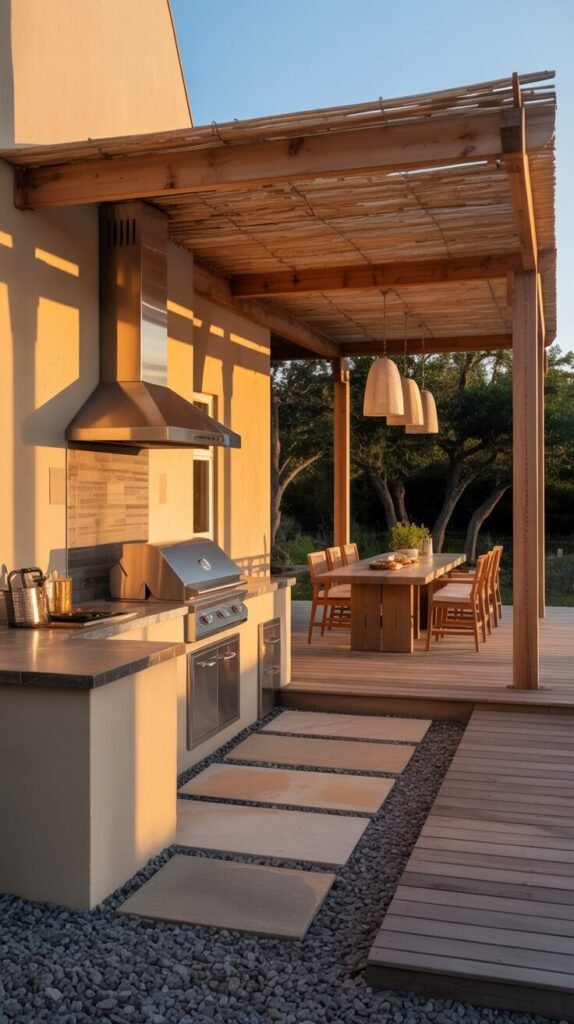
The second photograph, extremely subtle, gets the most out of a raised deck and overhead pergola to blow, “Hey, new space, new protocol!” The grill station is literally against the wall for maximum efficiency, and the dining table extended parallel creates a very clear “serve and eat” axis.
Floor treatment also changes—from gravel to decking—and the stepped path are like little pushes, steering your path. Each and every item is individually wrapped in a bubble, which prevents the entire air from being a crazy garage sale type of setting and practically makes you want to hang around.
Style tip: To create soft zoning, play with texture and elevation instead of barriers. A slightly raised platform or change in floor pattern can define zones while keeping everything cohesive and breathable.
Anchored by the Right Elements—Why Focal Points Matter
A focal point is not a pretty mug; it’s that visual anchor keeping a space grounded from drifting off into space. In kitchen design, these visual superstars are soothing your eyeballs, cutting through the functional items, and imposing order without rude physical boundaries. Without them, a room can be as neat as a sugar-high toddler playroom—wild and utterly incomplete.
Good focal points get their power from contrast, hierarchy, or repeat—height, light, texture, or good old-fashioned alignment. The point, people, is intention: a focal point must draw like a magnet but never be a demanding, diva-like attention-grabber. When done well, it’s a gentle guide for your feet, a mood elevator, and turns the design from “meh” to “masterpiece.”
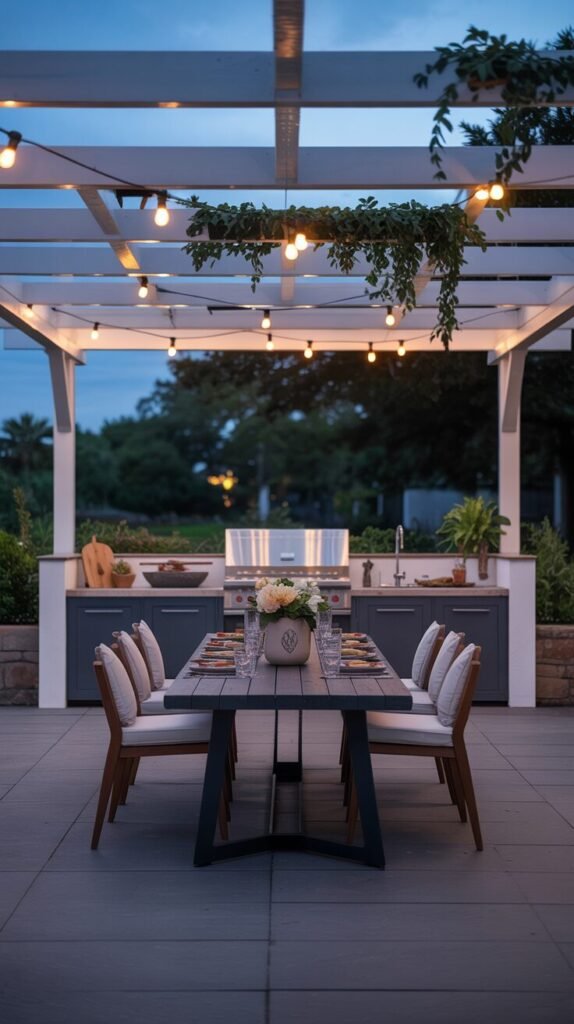
The look employed here (the one accustomed to viewing what is aesthetically pleasing) utilizes symmetry and alignment in order to position the dinner table as the obvious visual focal point. The grill wall in the background is fulfilling its subsidiary role, elegantly keeping all eyes focused on the headliner: the meeting place.
All that ascending pergola and all these string lights are vertical exclamation points, and the beautiful centered flower bouquet is a mic drop in spatial balance. This installation is not just a pretty thing to behold; it’s a polite but firm book for visitors. You just know where to stop at, where to glance and where all the positive vibes are at.
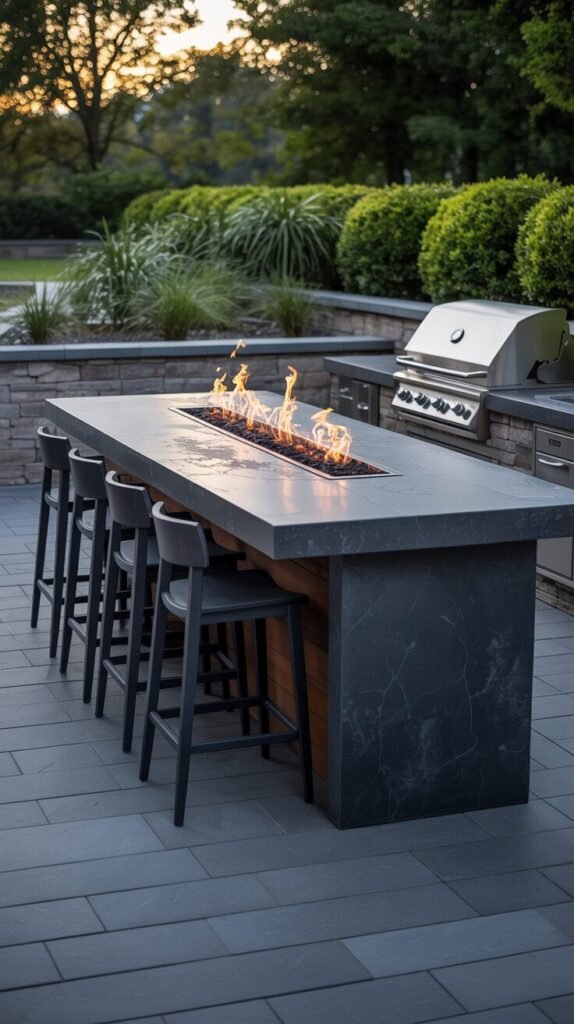
And then of course there is this one. Within this context, here, the fireplace, thoughtfully integrated into the island, is the unapologetically uninhibited focal point—both viscerally and mentally. Flames, they are-as-we-can’t-help-but-watch dancers, provide vertical movement and warmth, almost hypnotizing your eye and drawing humans to a full hip flame like moths.
The linear burner is cleverly designed in island shape, providing a pleasant congruence of form. Since the island is, so to speak, the hub of prep, serving, and entertaining, the fire is a dramatic centerpiece without adding a wrench to the mix. It places the whole experience in its best physical and emotional position. Hot commodity can’t even compare.
Style tip: Let your focal point set the tone: Whether it’s sculptural, architectural, or elemental—make sure it aligns with how the space is used. A focal point that’s seen, felt, and functional always resonates deeper.
Light as a Spatial Tool—Not Just for Mood, but for Structure
Human beings, take notice: light is not only an in-evening mood-setter (though it’s clearly well-suited to do that too). Light is a speedy space dictator outside when used to define spaces, mark your cooking-step nomad feet, and even shine where light’s required. A heck of an upgrade from walls or cheesy dividers, light sets friendly but firm boundaries between your cooking, prep, eat, and bedroom spaces. It’s an air-clear velvet rope.
With courtesy thought—it drifts along corridors, hovers above shelving, or slides across worktops—it provides rhythm and form that would enviously covet even a computer. It is a crumb trail of courtesy in the real world, so it attracts in neat, orderly fashion and takes on shape even at enormous scale. That is the trick of light as form: it drifts freely and reaches position without weight. Sheer brilliance, if I’m wrong.
And here in this very first photograph, light is substituting for walls but not walls. Path lights light up an actually incandescent hall, greeting visitors to the out-doors kitchen with grace. The station sconce lights are really building the vertical corner of the house, and the uplight on the tree is building the back like a ghostly phantom shroud. It’s all so nicely accomplished—opening itself to you, easy to maneuver about, and just sitting there being what it ought to be.
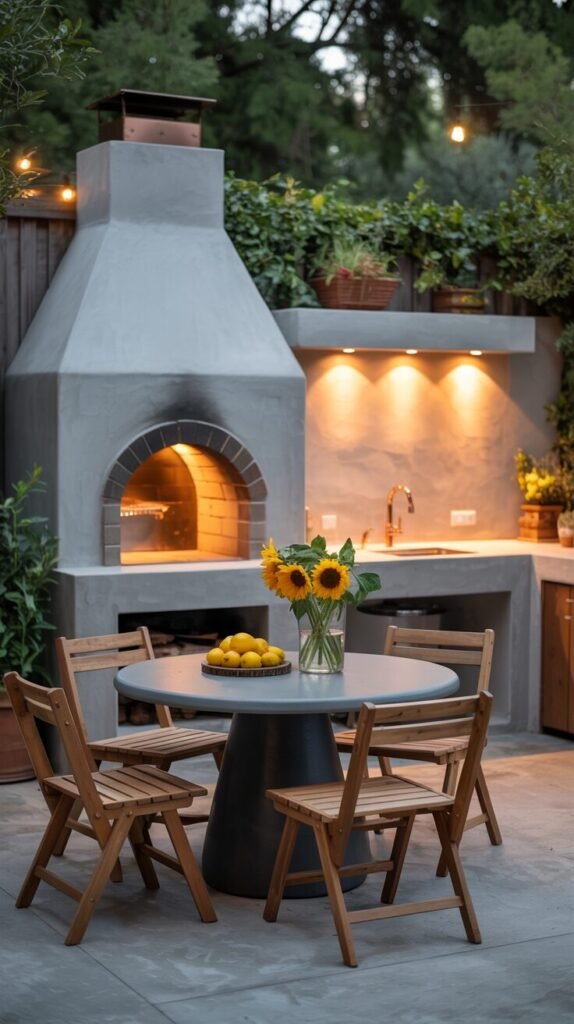
This. A demonstration of what layer lighting can accomplish to create a whirlwind of rooms out of one of the smallest rooms. That shelf light back there by that wall? Not playing at ambiance (though wonderful at), but actually setting prep area, offering stern but autocratic compartmentalization of dining space.
Even warm, inviting scent drifting out of pizza oven is yelling, “Hey, hey! Look! I’m delicious!” and acting like in-the-process centerpiece, too. All those teeny-tiny clusters in aggregate are creating depth, hierarchy, and pretty without losing any shred of weight or drag. goodbye heavyweight walls!
Style tip: Think in layers, not just lumens.
Use ambient light to soften, task light to define, and accent light to lead the eye. This is how your outdoor kitchen becomes a space that “reads well” even after sunset.
READ MORE >> “Cedar, Redwood, Pine, or Ipe: Which Wood Makes the Best Fence?“
Designed to Flow, Built to Feel

A beautiful backyard kitchen doesn’t function; it functions socially. It’s a wonderful discussion regarding flow, balance, light, and rhythm. If there’s something worth talking about at the table, everything is constructed to remain upright during a hurricane, and every beam of light is utilized to its fullest for something other than the manner in which it appears, the house isn’t so much the dessert patio anymore but an experience. Buckle up to be blown away.
What appears so loose is choreographed dance of deferent choice—elegant approach guiding your eye expertly, flow channel guiding your motion expertly, and several patterns which you recognize and understand. Either you’re beginning with a blank sheet of paper or you’re merely looking to add some oomph to an idea that was original, bear in mind this small trick: great design never boasts; it hums in the background, and everything hums along. And provided it is done right, no one will simply look at your outdoor kitchen—they’ll feel it. Even deep within their heart.