
Unlocking Front Yard Beauty with the Golden Ratio: A Trick That Works (Almost) Every Time
Ever strolled past someone’s front yard and thought, wow, that just feels right—even if you couldn’t explain why? Chances are, it wasn’t luck. It was design, and the quiet secret behind it all is proportion. Not just any proportion, but the Golden Ratio, that timeless formula you’ll find in seashells, sunflowers, and yes, even in ancient architecture. It’s basically nature’s favorite blueprint.
Now, don’t worry if math wasn’t your strongest subject. The Golden Ratio is simply about 1.6 to 1, a proportion our brains naturally register as pleasing and balanced. Artists and builders have leaned on it for centuries because it works—and the same trick applies to landscaping.
In a front yard, this ratio helps shape everything from how wide a garden bed should be compared to its length, to where you place a focal point, to how you stack layers of plants so the tall ones don’t look like they’re trying to outcompete each other. Sprinkle a little of this math magic around and suddenly your yard doesn’t just look nice—it feels inviting, like it was always meant to be that way.
It’s not about chasing perfection. It’s about creating flow, rhythm, and harmony, so your home and garden feel like they belong together—kind of like the perfect wine and cheese pairing, but with more soil under your nails.
How to Apply the Golden Ratio to Front Yard Elements
When you start layering a touch of that magical 1.618 ratio onto the right details—think garden beds, those front steps you can’t seem to climb without tripping, or even a feature you’ve been dying for people to notice—you end up with a design that feels like effortless beauty.
Up next, we’re spilling exactly how to harness this little secret so every design choice works harder (and prettier) for you.
Golden Ratio: Walkway-Lawn Harmony
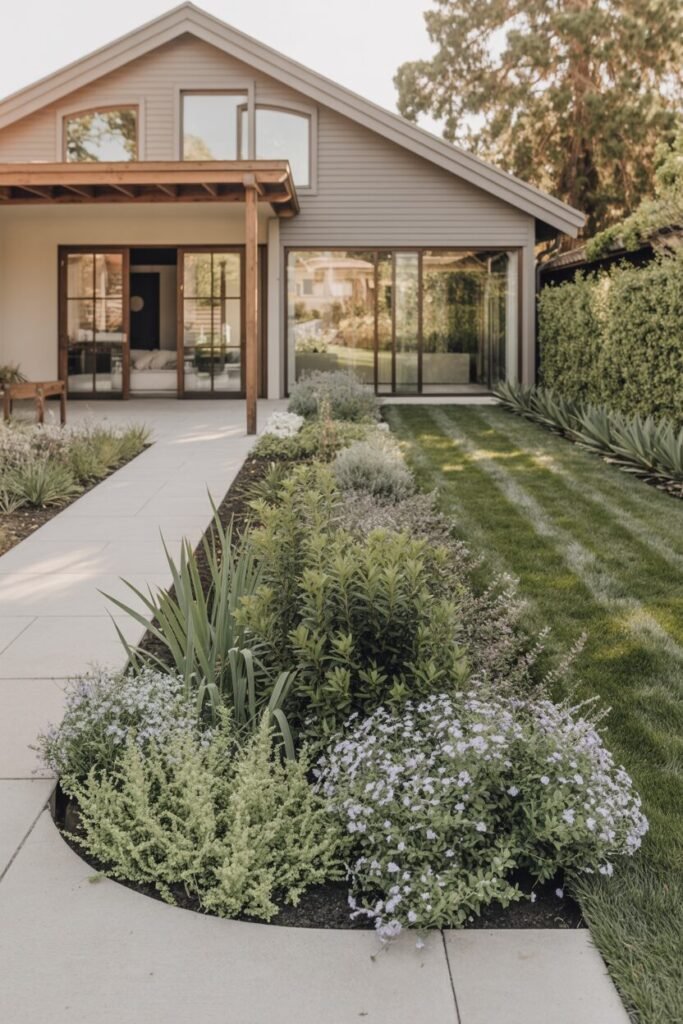
Here, a meticulously designed garden bed acts as a simple, graceful separator between two main areas. The genius of the design isn’t in the garden bed’s size, but in the harmonious relationship between the width of the clean, modern walkway and the width of the expansive green lawn.
This striking visual balance adheres to an approximate 1:1.6 proportion, making the entire landscape feel naturally harmonious. This deliberate choice creates a sense of calm and perfect equilibrium, proving that mathematical principles can lead to beauty in nature. The garden bed merely serves as the ideal dividing line, allowing the eye to appreciate this masterful, proportional relationship.
Before you start recreating this, use a measuring tape to carefully mark out the planned width of your walkway and the adjacent lawn area. Remember, the golden ratio is a guideline, so a close approximation is perfectly fine. The goal is to create that visual harmony.
Divide Lawn and Hardscape Using 1/3 and 2/3 Balance
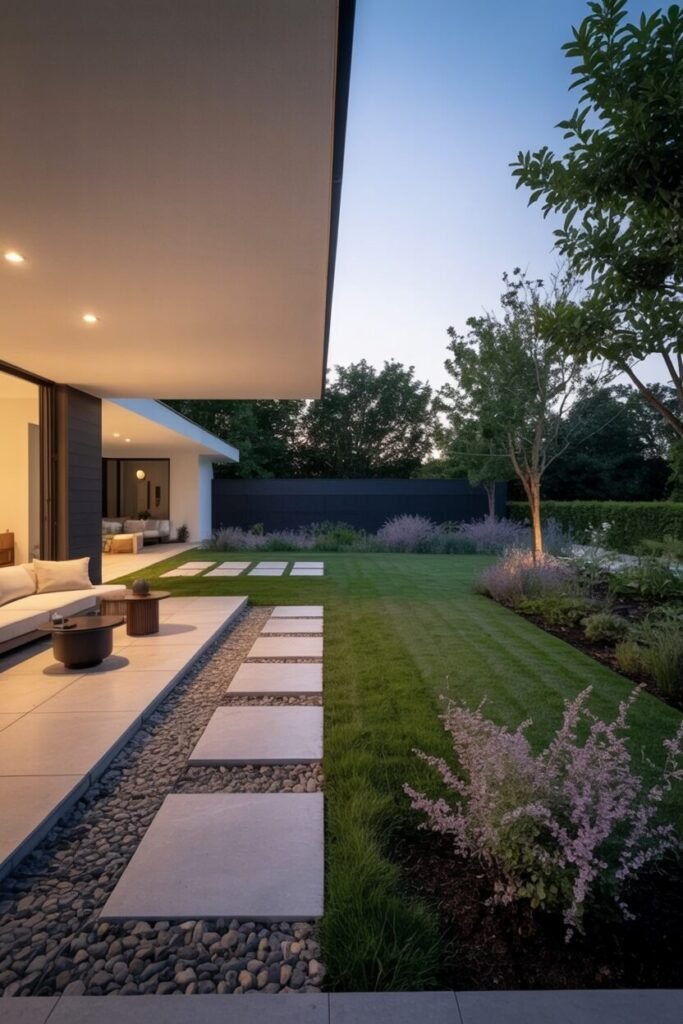
One of the classic rookie moves in front yard design is chasing perfect symmetry, like everything has to match on both sides. The truth? Symmetry and balance are not the same thing at all. Balance is more about proportions—and that’s where the good old one-third to two-thirds rule comes in to save the day.
Take another look at that photo. Notice how one-third of the space is dedicated to the sleek new patio and gravel, while the other two-thirds are left open for a soft green stretch of lawn and relaxed plantings. That intentional “off-balance” look isn’t sloppy—it’s design at work. It creates flow, hierarchy, and breathing room, so the whole yard feels open and calm instead of cluttered or stiff.
When you’re laying out your own yard, this ratio can be a total lifesaver. It keeps your grass from being squeezed into a tiny corner or, worse, looking like it was thrown in at the last second.
Style advice: Pretend you’re sketching like a pro. Imagine your front yard as one big rectangle, then slice it into three strips. Dedicate one to patios, gravel, or walkways, and let the other two shine with greenery. Suddenly, your yard looks like a stage—and the plants are the stars of the show.
Layer Plant Heights in Golden Steps
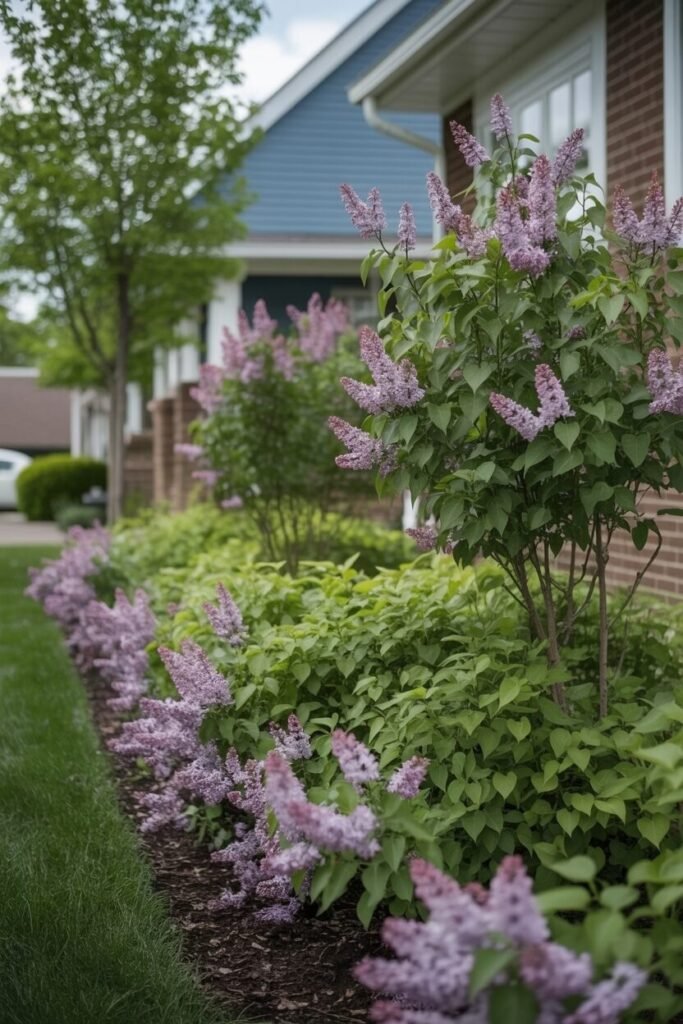
One of the most stunning ways to use the Golden Ratio in your front yard is through plant layering. Instead of lining shrubs in a stiff, military row, think in tiers—what we like to call “Golden Steps.”
Look at the photo above. The planting practically sings. Low lilacs create the first gentle line, mid-height greenery fills the middle which is about 1.6 times taller than the low lilacs, and the taller lilac bushes here act as a “topping.”
Style trick: When planning a new bed, start with your shortest plants in front. Then, choose a middle layer that’s around 1.5 to 1.6 times taller, followed by an even taller backdrop. Repeat as needed. The result? Depth that feels warm and inviting, never flat or forced..
Frame the Front Door With Unequal Planting Zones
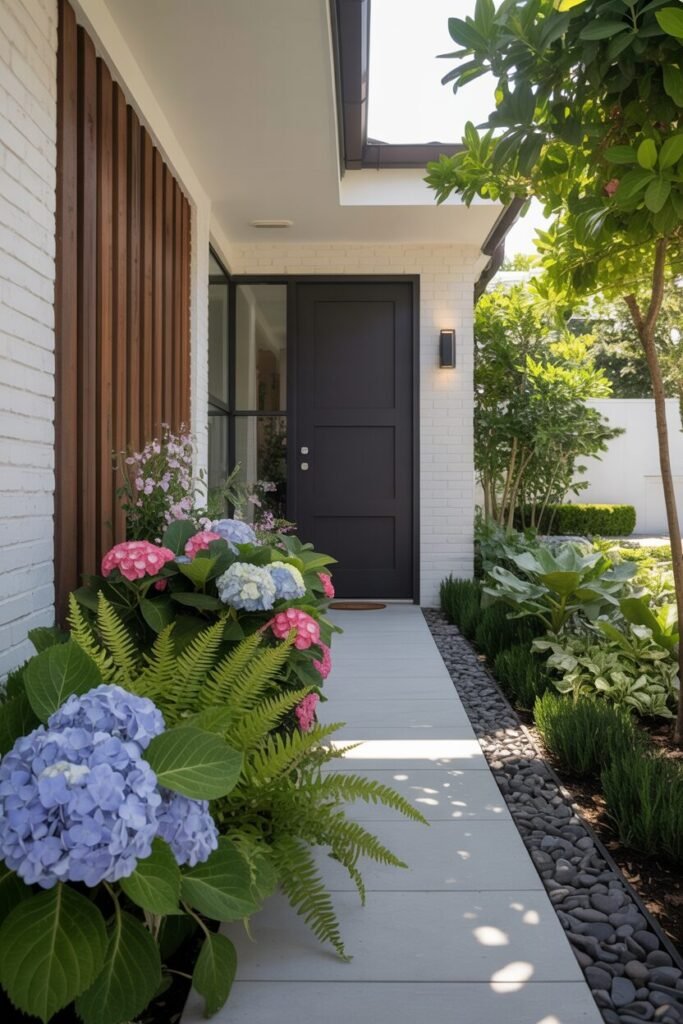
There’s something about an enclosed front door that feels irresistibly charming—but in a slightly awkward, “my parents made me pose for this picture” kind of way. Instead of forcing stiff, matchy-matchy symmetry, try leaning into off-center planting beds inspired by the Golden Ratio. It’s such a small shift, but it creates a huge visual payoff.
Take a closer look at the photo, how one edge of the walkway, right by the front door, feels lush and abundant—those big hydrangeas, the playful ferns, and bursts of bold flowers really pack it in. Now glance at the other side. It’s intentionally softer, calmer, with low-growing plants and a peek of pebble hardscape. That balance isn’t random; it’s carefully designed harmony at work.
By loading up one side with about 1.6 times more visual weight—whether that’s height, vibrant color, or sheer fullness—you’re tapping into the Golden Ratio to guide the eye toward the door naturally. Nothing forced, nothing rigid—just a beautifully choreographed rhythm that feels effortless.
Style tip: Pick your “golden side” based on sunlight—or honestly, wherever you want the drama to shine. Then let the opposite side breathe with lighter, airier plants. Even your garden deserves a little stage presence.
READ MORE >> “9+ Inspiring Backyard Landscaping Ideas That Transform Outdoors“
Shape Curved Beds Using Golden Arcs
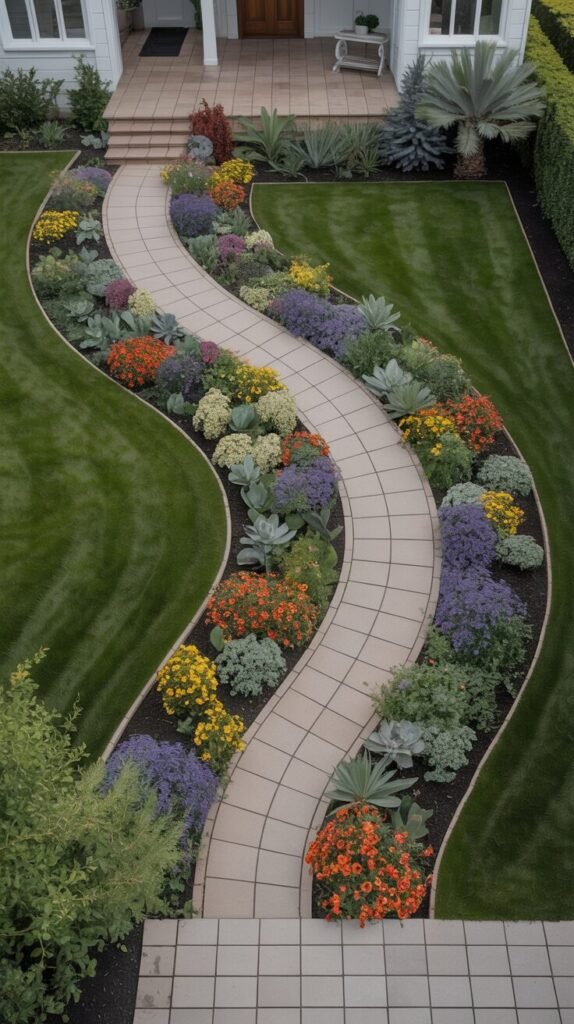
Curves don’t have to be loud or dramatic—they’re actually one of the smartest ways to create flow, guide the eye, and bring an emotional rhythm into your front yard. And when those curves are shaped with the Golden Ratio in mind, they’re not just decorative. They carry meaning.
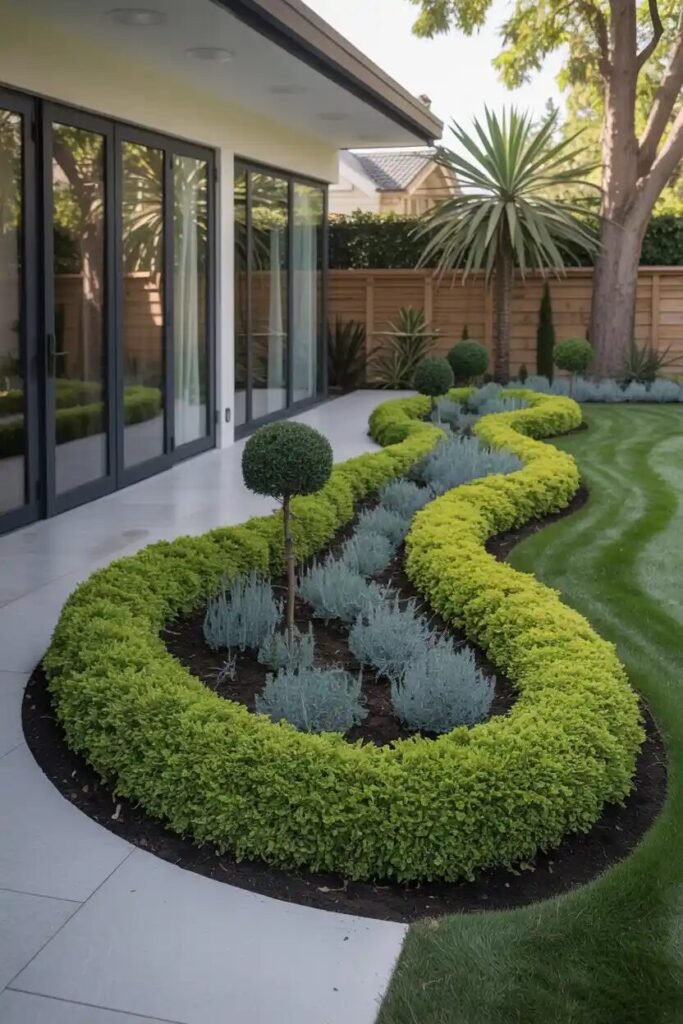
Take a look at the photo above, where the garden beds gently echo the curve of the path, almost like a love letter to the Golden Spiral—that timeless shape we see in seashells and the spiraling seeds of a sunflower. These curves aren’t sharp or awkward. Instead of rushing you around a bend, they ease you in, one after the other, creating a calming rhythm that naturally draws you toward the entrance.
Here’s where the magic happens: the ratio of 1:1.6 (the Golden Ratio) shows up in the spacing and depth of the curves. The tighter, narrower start gradually opens up to a broader sweep—about 1.6 times wider than where it began. This subtle proportion keeps your eye moving comfortably along the path, never feeling forced or uneven. It’s why your brain says, ah, this looks right. Without it, the curves could feel too cramped or too stretched out.
That balance is what makes the design feel almost like visual ASMR—relaxing, natural, and deeply satisfying.
Style hack: When planning curved beds, grab a garden hose or a sturdy rope and sketch out a spiral on the ground. Let the first part stay narrow, then let the curve expand so the widest part is about 1.6 times bigger than the starting point. That’s how you mimic the Golden Ratio and create flow that feels effortless.
Group Outdoor Lighting Using Golden Spacing
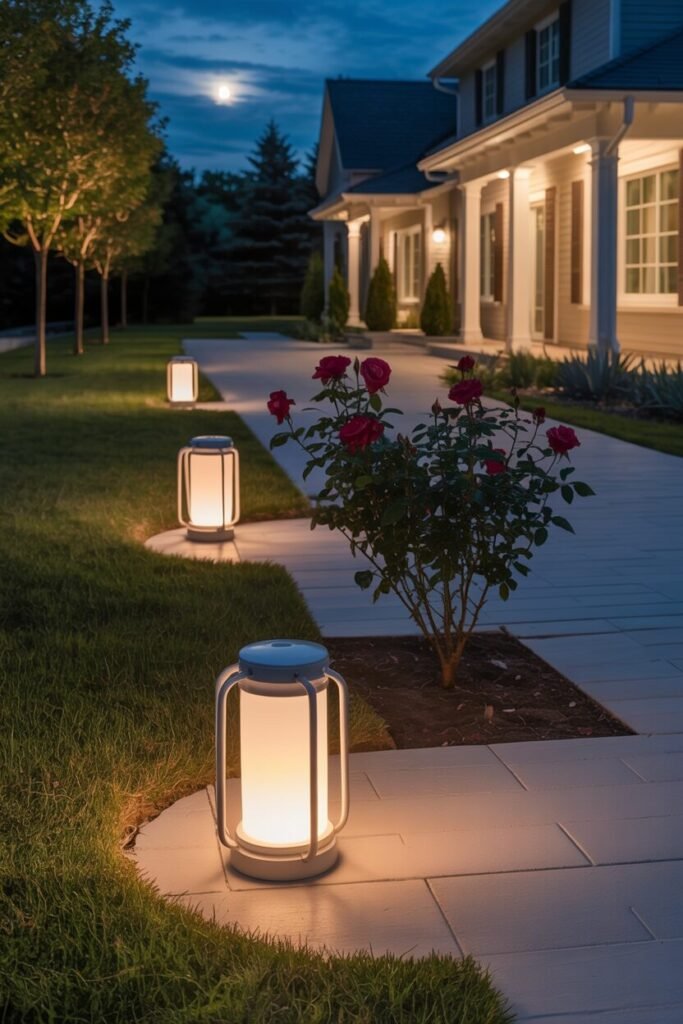
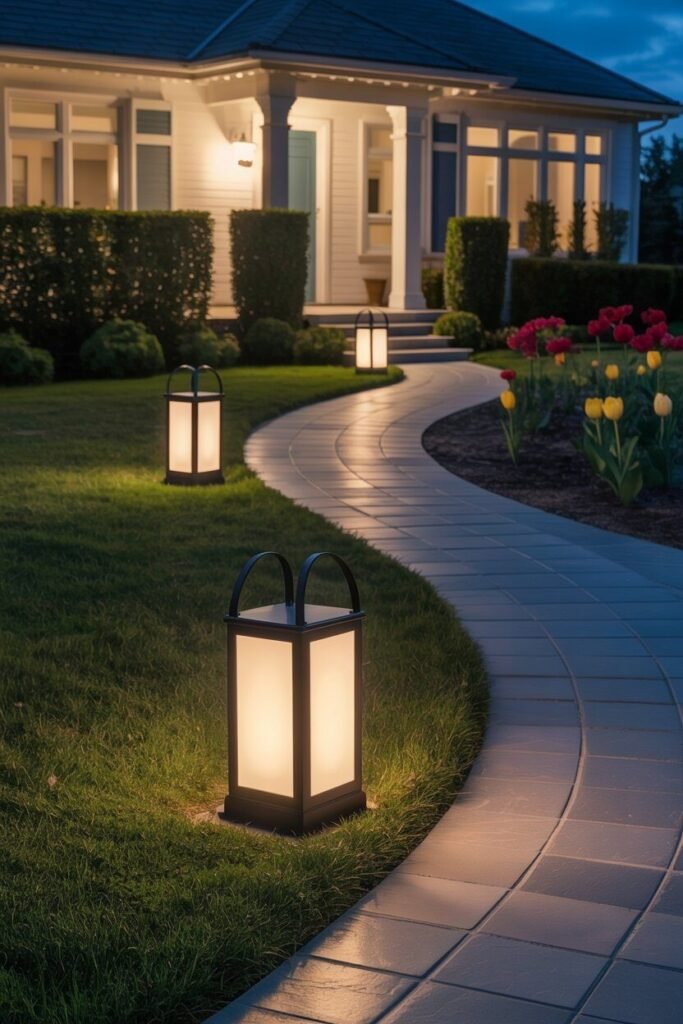
Good outdoor lighting isn’t just about flipping a switch so you don’t trip over a shrub at night—it’s about creating rhythm. One of the most overlooked tricks to make your lighting feel alive is spacing your fixtures with the Golden Ratio in mind.
Look at the photo. Notice how the lights don’t march stiffly every five or ten feet like soldiers on duty. Instead, they cluster in spots. The spacing grows gradually, echoing the Fibonacci sequence (where the distance between each successive light adheres to an approximate 1:1.6 ratio—for example, distances of 5 feet, 8 feet, 13 feet, and so on), which is built right out of the Golden Ratio itself.
The result? No “airport runway” vibes from evenly spaced monotony. Instead, you get moments of pause and focus, like beats in a song, guiding your eyes naturally down the path. It’s movement, not monotony—a dance, not a drill.
Style hack: Begin with the first light by your front door, around 5 feet. Then stretch the distance to 8 feet, then 13 feet, and keep going. That variation ties the design together, feels intentional, and spares you from that generic hardware-store look.
READ MORE >> “9+ Beautiful Coral Bells Front Yard Landscaping Inspirations“
Balance in Every Step, Beauty in Every View
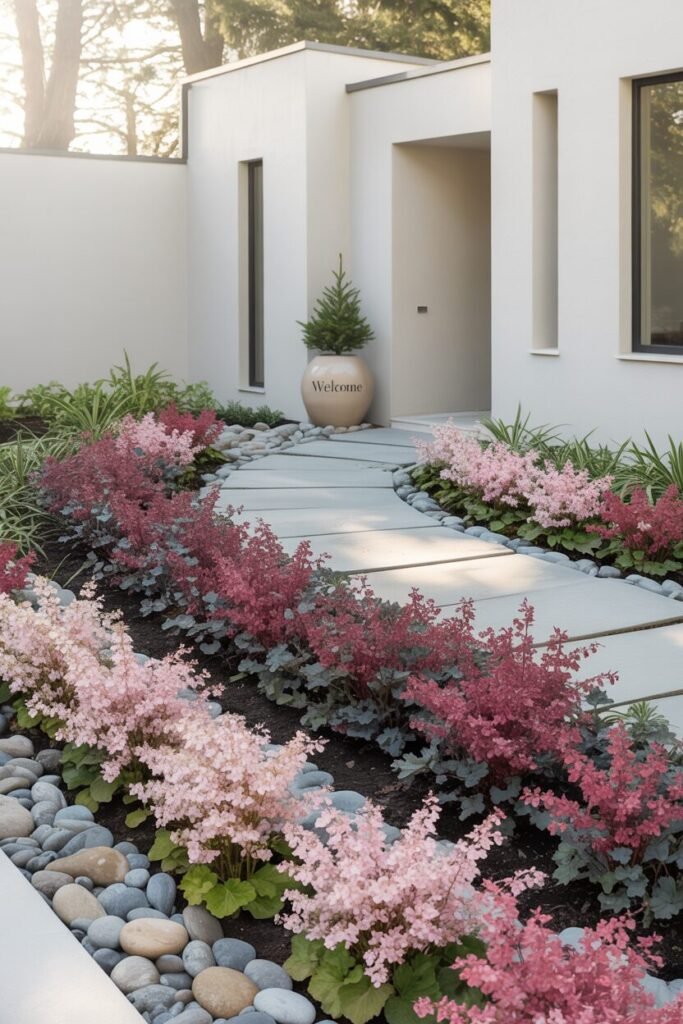
At the heart of every great front yard is a sense of balance, and the Golden Ratio gives you a timeless way to find it. From curved pathways that flow like nature intended to lighting and paver grids that feel rhythmic instead of rigid—these subtle touches transform ordinary yards into something truly memorable.
The beauty of working with 1:1.6 proportions is that it never feels forced; it feels like the space was always meant to look that way. Whether you’re clustering plants, setting outdoor lights, or arranging features, think of it as creating a melody your eyes can follow.
With the Golden Ratio as your guide, your front yard becomes more than a welcome—it becomes an experience.