
Small Apartment Living Rooms Built Around Lighting Instead Of Extra Floor Space
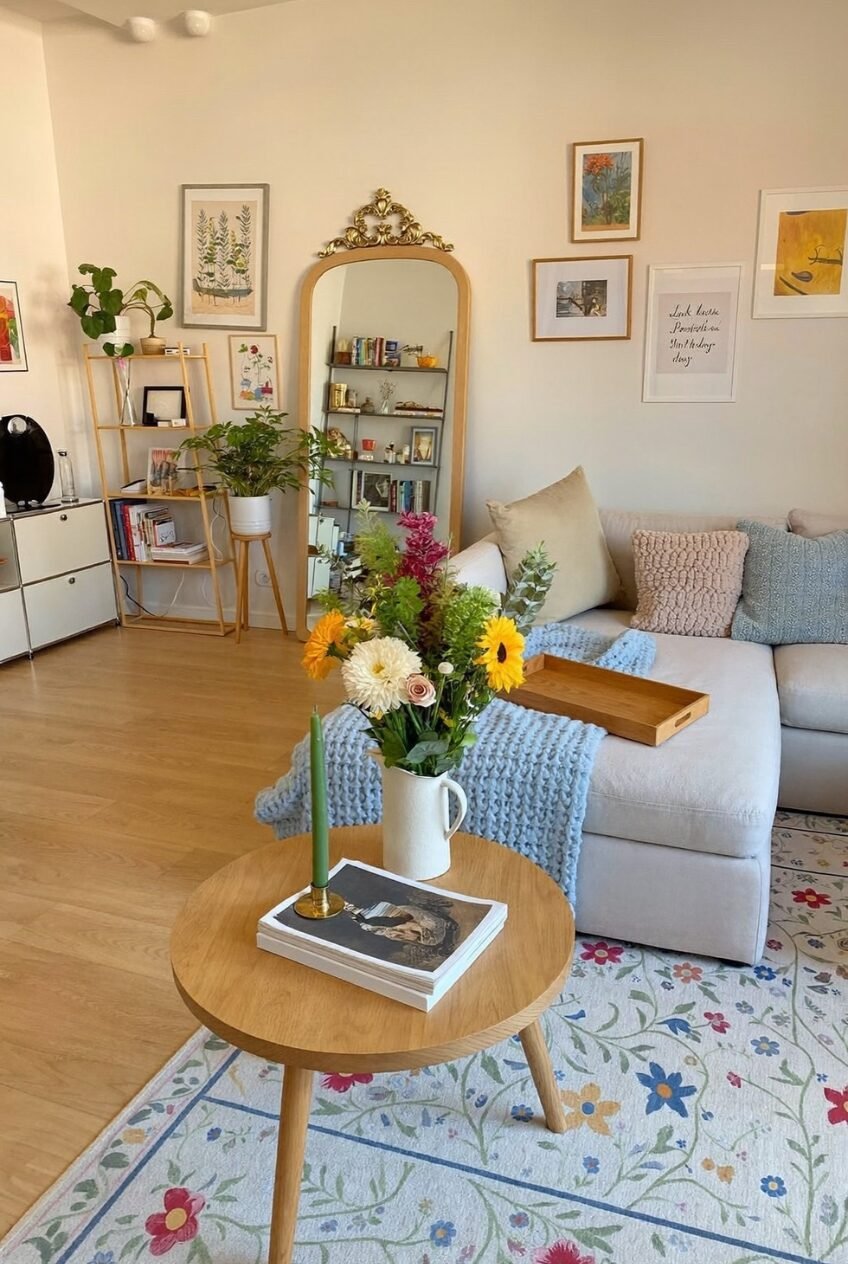
Small apartment living rooms get a bad reputation, like they’re something to apologize for. We don’t buy it. The tightest rooms often end up being the most personal ones in the whole house, mostly because every single object in them had to earn its spot before it was allowed to stay.
Talk to anyone who has actually lived in a compact space and they’ll tell you the real skill isn’t hiding the size, it’s working with it. Layered lighting, a rug that grounds the seating, plants that soften hard corners, these are the moves that make square footage feel almost irrelevant.
We pulled together ten real rooms that prove a small footprint and a flat, forgettable room are not the same thing. Grab whatever’s closest to your own space and steal the parts that actually make sense for it.
Small Rooms Glow After Dark
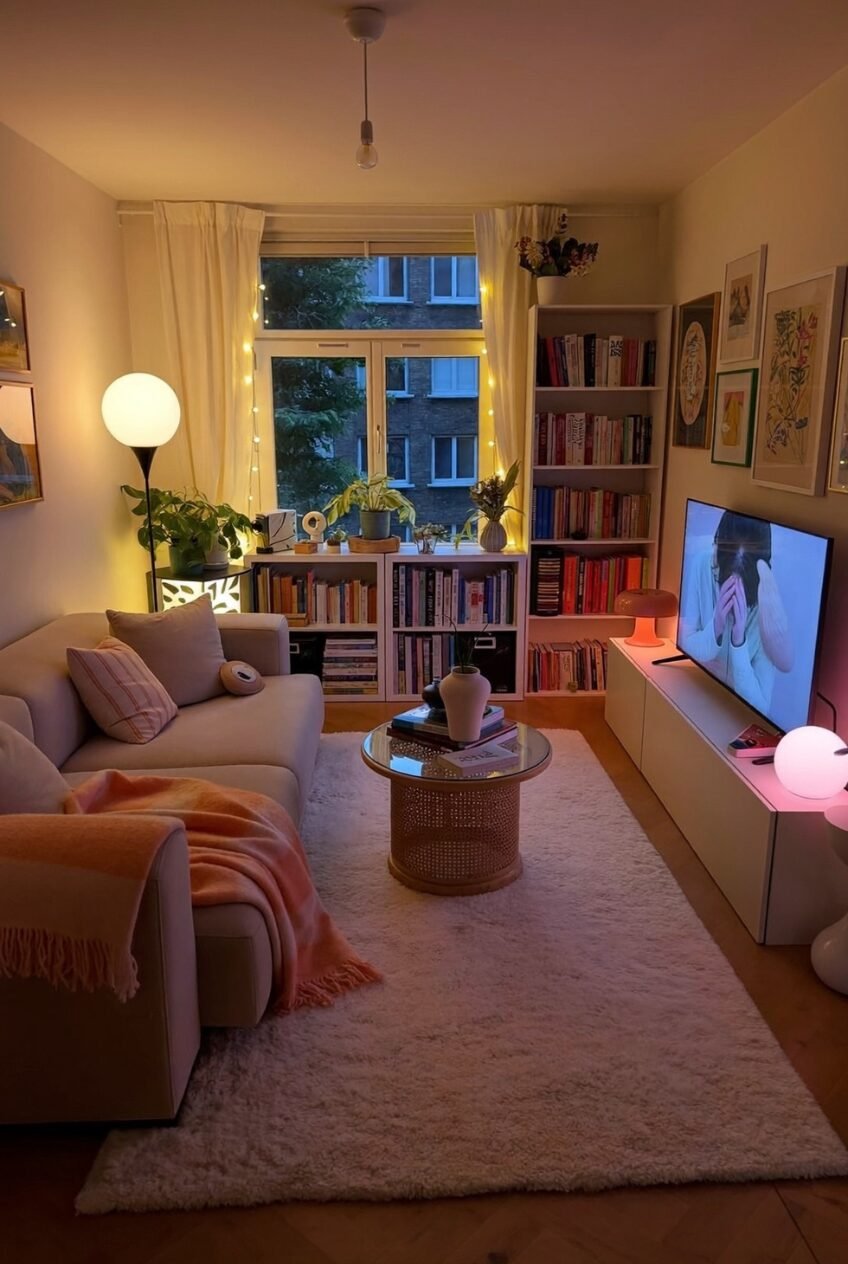
The lights are off in daytime photos of small apartments for a reason, because a room like this actually looks better with a lamp on than it does with a ceiling fixture blasting overhead. This one leans hard into that idea, with a floor lamp, two glass globe lamps, and a string of fairy lights doing basically all of the real work.
A small room lit by one central bulb tends to feel like a waiting room. Multiple low, warm light sources at different heights trick your eye into reading the space as bigger and softer at the same time. Add a shaggy rug underfoot and a boxy layout stops feeling boxy almost immediately.
If your shelf is already packed with books, don’t hide it, style around it instead. Slide a small lamp between the stacks, tuck a plant on the ledge, and let the clutter read as personality rather than chaos. A blanket tossed over the arm finishes the mood without one extra shopping trip.
Let Open Shelving Divide The Space
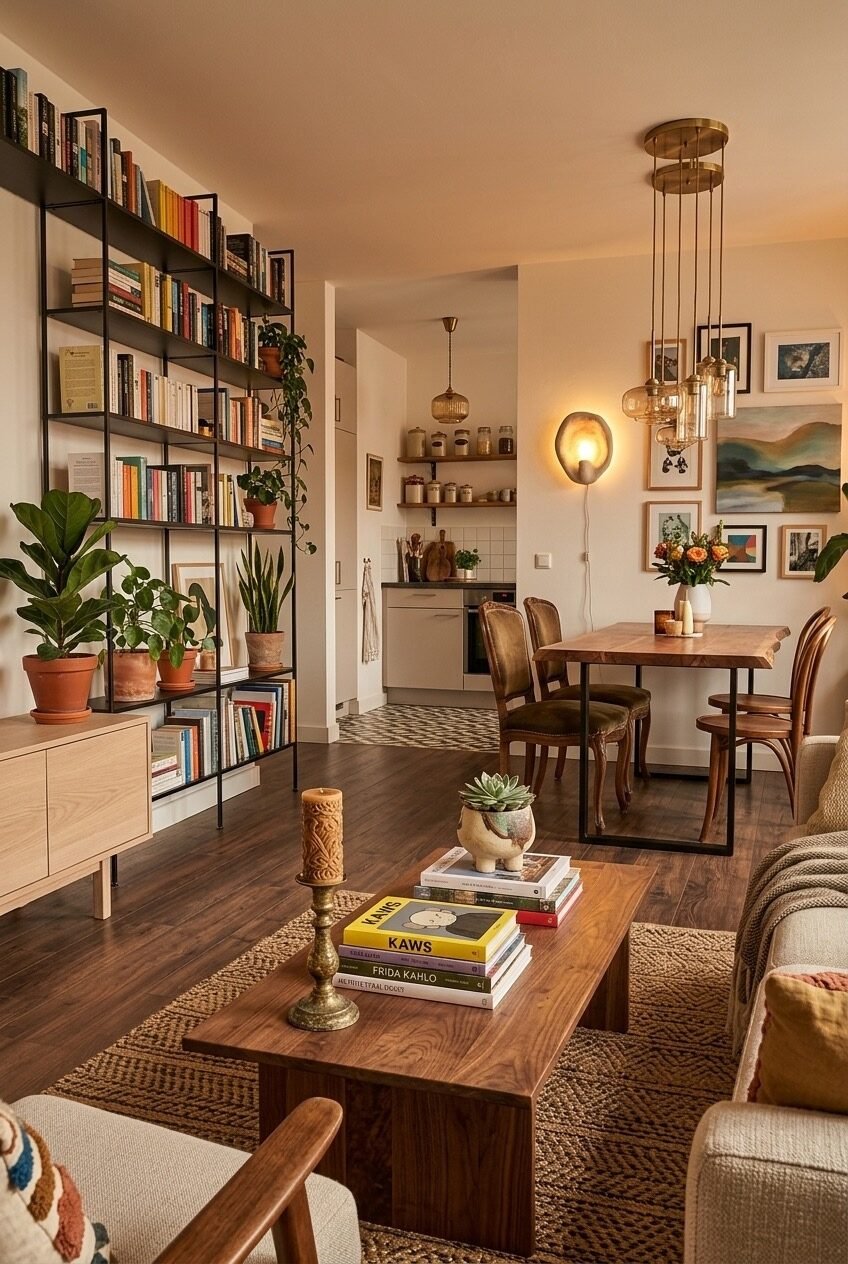
Open shelving does double duty in a small apartment because it stores things while also acting as a see-through wall between two zones. Here it separates the seating area from the dining table without blocking a single ray of light, which is basically the whole point of living somewhere without a real hallway to spare.
Notice how the pendant lighting over the table hangs low and warm instead of bright and clinical. Warm brass fixtures paired with wood tones read like a choice, not a bunch of leftovers from ten different apartments. That contrast is doing more than any single piece of furniture in the room.
Stack your coffee table books instead of fanning them out, prop a candle holder next to the pile, and let the mismatched dining chairs stay mismatched. A room made entirely of one matching set usually looks like a showroom, and nobody actually wants to live inside a showroom.
Minimalism Still Needs Personality Somewhere
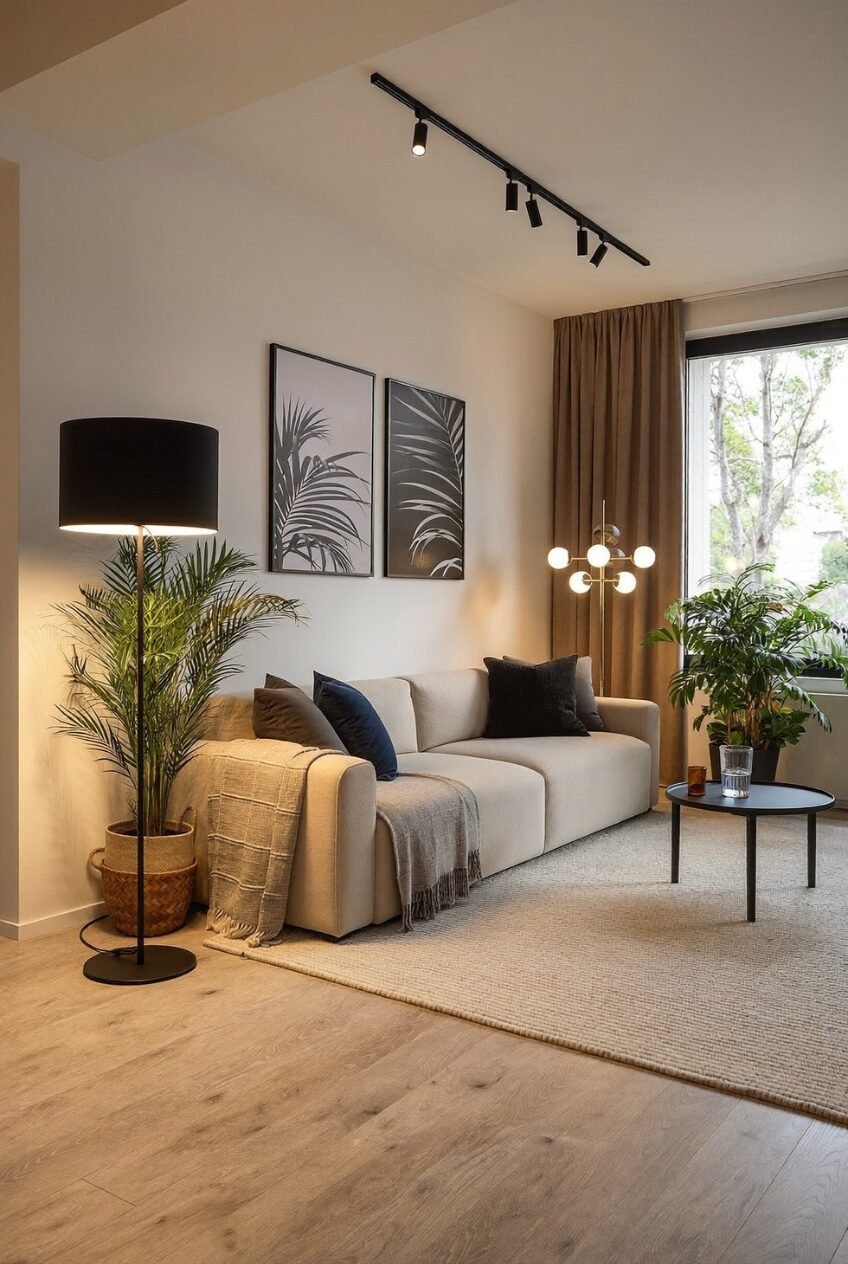
Neutral doesn’t have to mean boring, though plenty of small apartments get stuck there because beige simply feels safe. This living room stays quiet in color but goes a little wild with lighting, mixing a track light, a drum shade floor lamp, and a gold sputnik fixture in one single sightline.
Mixing lighting styles in a small footprint works better than mixing furniture styles, mostly because light fixtures don’t compete for floor space the way an extra chair or side table would. A dramatic lamp next to a plain sofa gives the eye somewhere interesting to land without adding any real bulk to the room.
Two matching botanical prints keep the wall from feeling like an afterthought, and a real potted palm in the corner softens all those straight lines coming from the track lighting and window frame. Buy one statement lamp before anything else, and the rest of the room tends to follow its lead.
Pink Can Carry A Whole Room
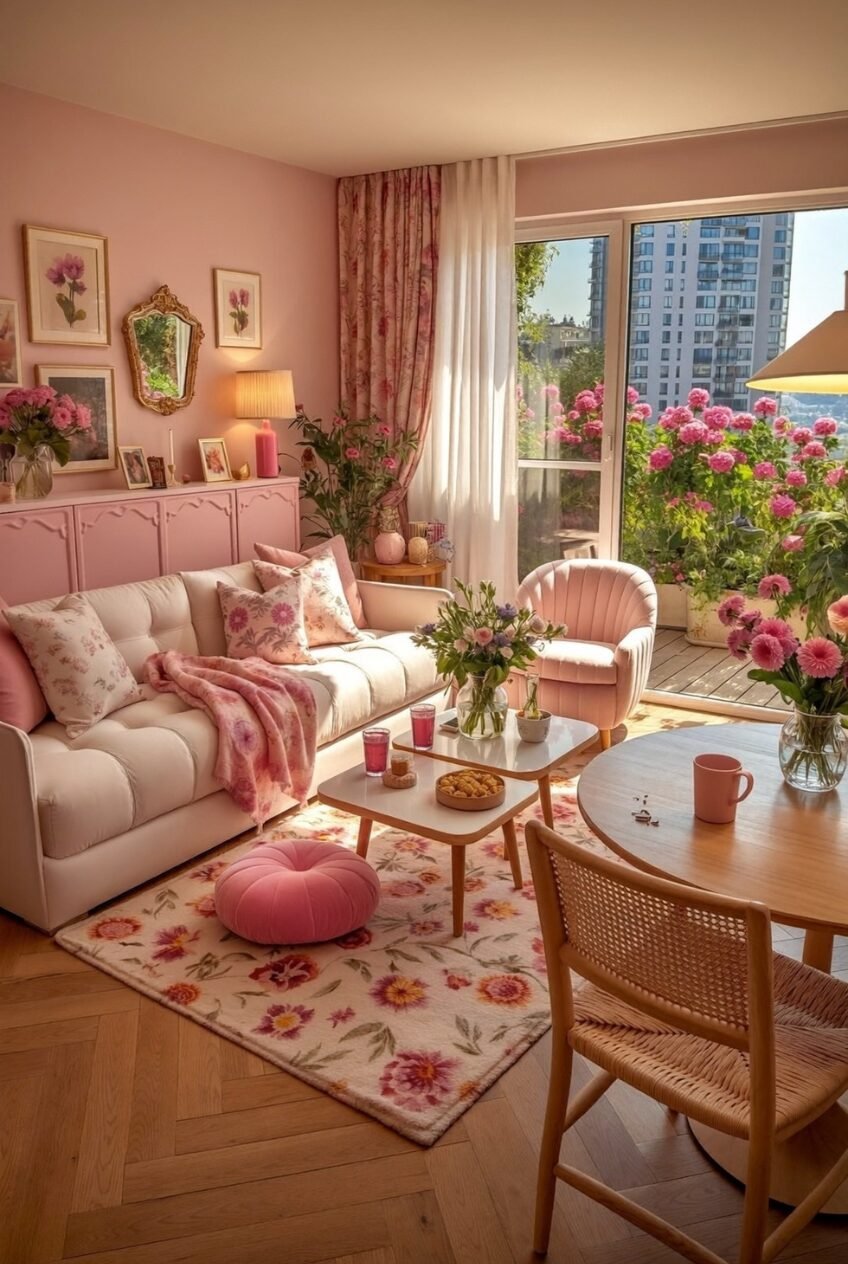
Painting an entire small room one saturated color sounds risky until you see it done well, and this one commits fully, walls, curtains, even the cabinet along the back wall. Going all in on a single shade in a tight space actually reads calmer than three neutral tones fighting each other across the same square footage.
The floral rug and matching curtains aren’t matchy by accident, they’re pulling the same color family through the entire room so nothing feels random or thrown together. A repeated color story does more visual work than any single piece of furniture ever could.
If a full pink wall feels like too much of a leap, start smaller. Paint one wall, add a floral rug, and let a balcony full of real flowers outside do the rest of the convincing. A small space with a clear point of view always beats a big one with none at all.
Animal Print Works In Small Doses
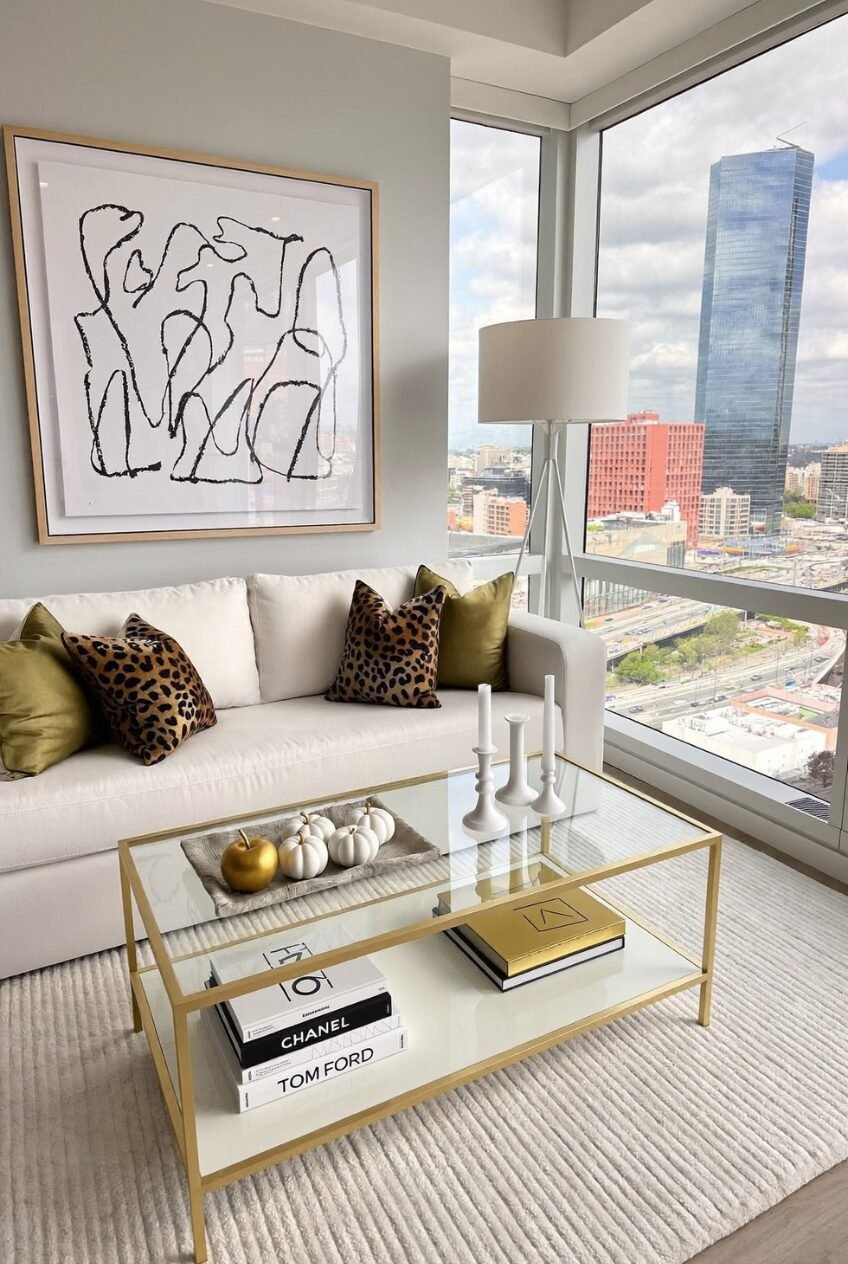
A little leopard print goes further than most people expect, and this room proves it by keeping the pattern to two throw pillows against an otherwise cream and gold palette. Anyone nervous about pattern can start exactly here, with pillows that are cheap and easy to swap out later if the mood changes.
The glass and gold coffee table stacked with coffee table books does a lot of quiet, heavy lifting. Glass furniture in a small room takes up visual space without actually taking up any real space, which matters more than people tend to realize once square footage gets genuinely limited.
Pair a bold view, if you’re lucky enough to have one, with a fairly restrained interior so the window gets to be the loudest thing in the room. Everything else here, the candles, the little seasonal pumpkins, stays quiet on purpose so the skyline never has to compete with the furniture.
Small Apartments Can Hold Big Color
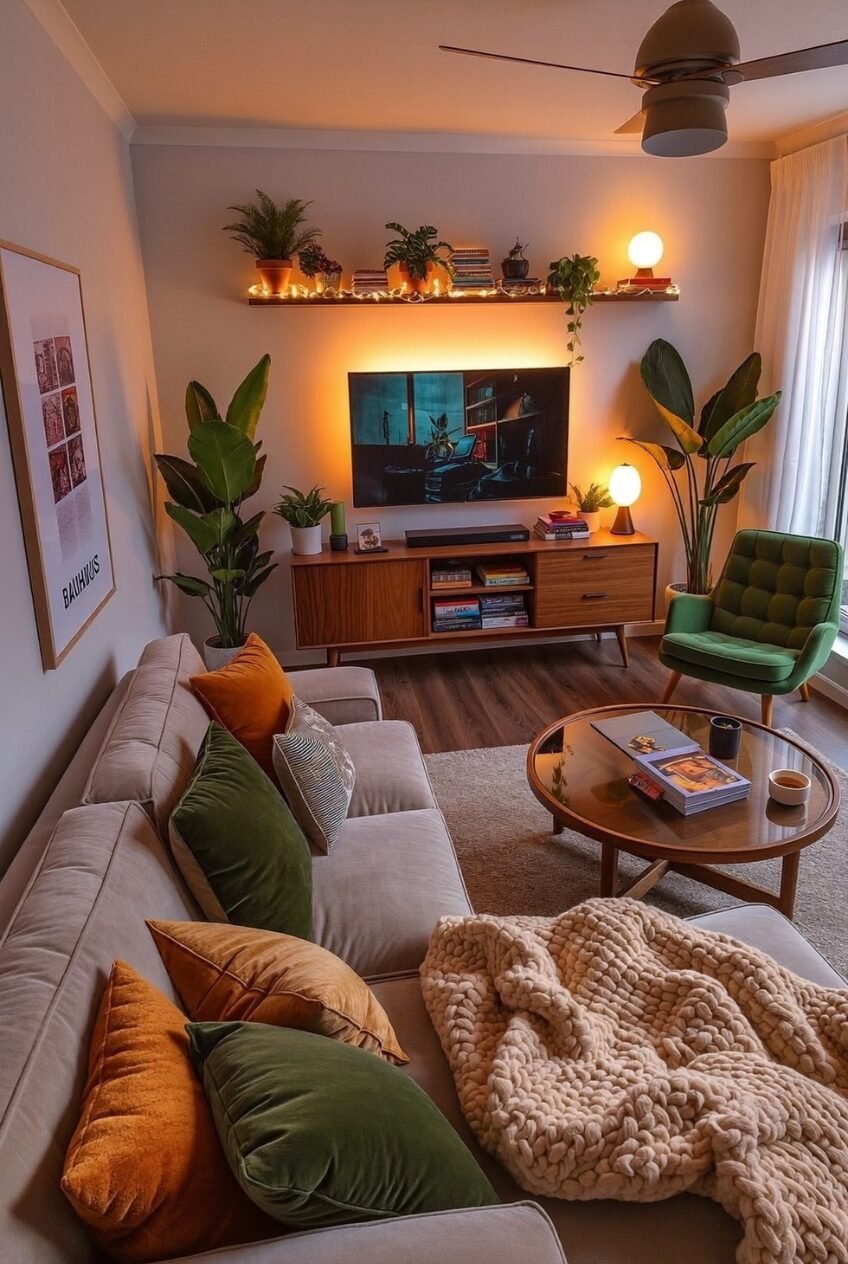
Mustard, olive, and warm brown pillows piled onto one gray sofa should probably clash, and somehow they don’t, because they all sit within the same warm, saturated color family. That’s the actual trick with color in a small space, stay in one temperature and almost any combination will hold together.
The floating shelf above the TV, holding plants and a string of warm lights, turns an otherwise awkward blank wall into the real focal point of the room. A shelf with plants and warm light does more for a room than a bigger television ever will.
A green velvet accent chair gives the whole setup somewhere else to land besides the couch. If your apartment only has room for one extra seat, make it a colorful one instead of a folding chair, it earns its keep as both seating and as decor at the same time.
Narrow Rooms Need A Focal Point
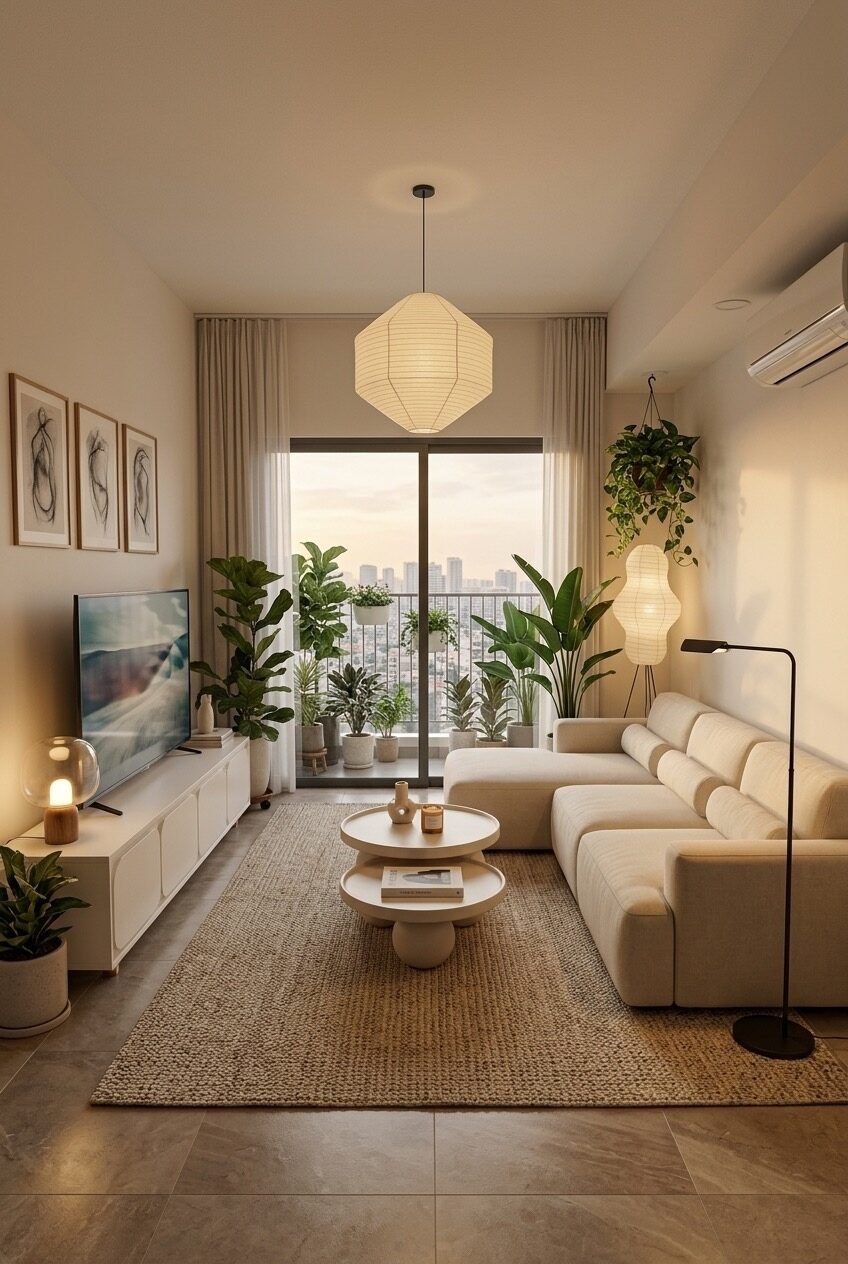
Long, narrow living rooms have one job to solve before anything else, and that’s stopping the eye from just sliding straight down the length of the space. A large paper lantern pendant hung dead center does exactly that, giving the room a clear middle instead of one long, forgettable blur.
The jute rug anchors the seating zone so it doesn’t feel like it’s floating somewhere in a hallway, and the wave shaped nesting tables add a little movement without adding any real bulk. A rug is the fastest way to define a zone in a room with no walls to work with.
Fill the far end, near the window, with plants of different heights instead of one tall one. It gives the room layers to look through as you walk in, and it turns what could easily be a dead corner into the best looking part of the entire apartment.
Moody Rooms Need Warm Materials Too
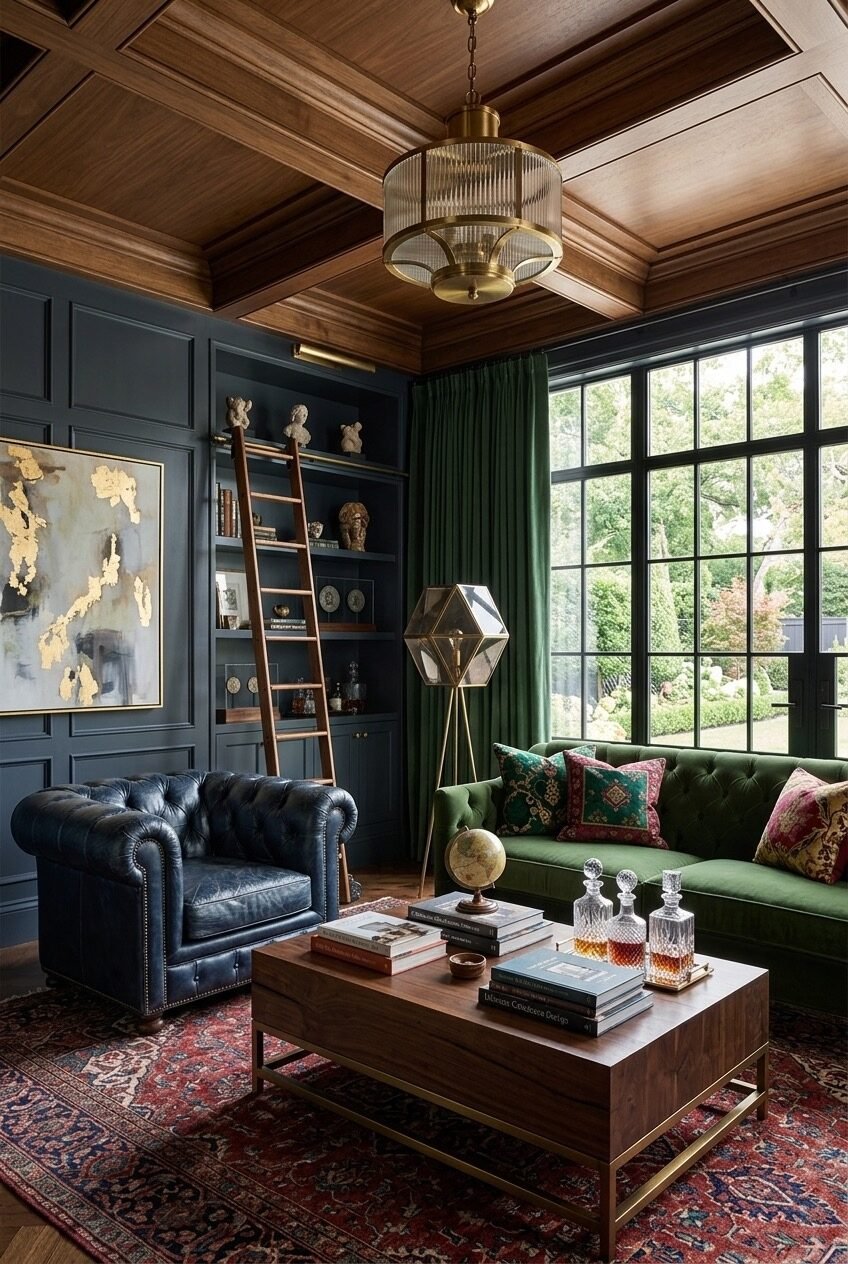
Dark walls in a small room scare people off more than they probably should, but the fear usually comes from picturing flat, cold paint sitting next to cold metal fixtures. This space avoids that entirely by wrapping deep charcoal walls in warm wood paneling and brass detailing, so the whole thing feels rich instead of gloomy.
Layering navy, forest green, and warm wood keeps a dark palette from feeling heavy. A jewel toned velvet sofa against paneled walls reads like a proper library corner even if the actual square footage is a fraction of what this particular room has to work with.
You don’t need a wall of built ins to borrow the mood. One deep colored armchair, a small brass lamp, and a patterned rug in the corner of your own living room can carry the same feeling on a much smaller budget and a much smaller floor plan.
Let Jewel Tones Do The Talking
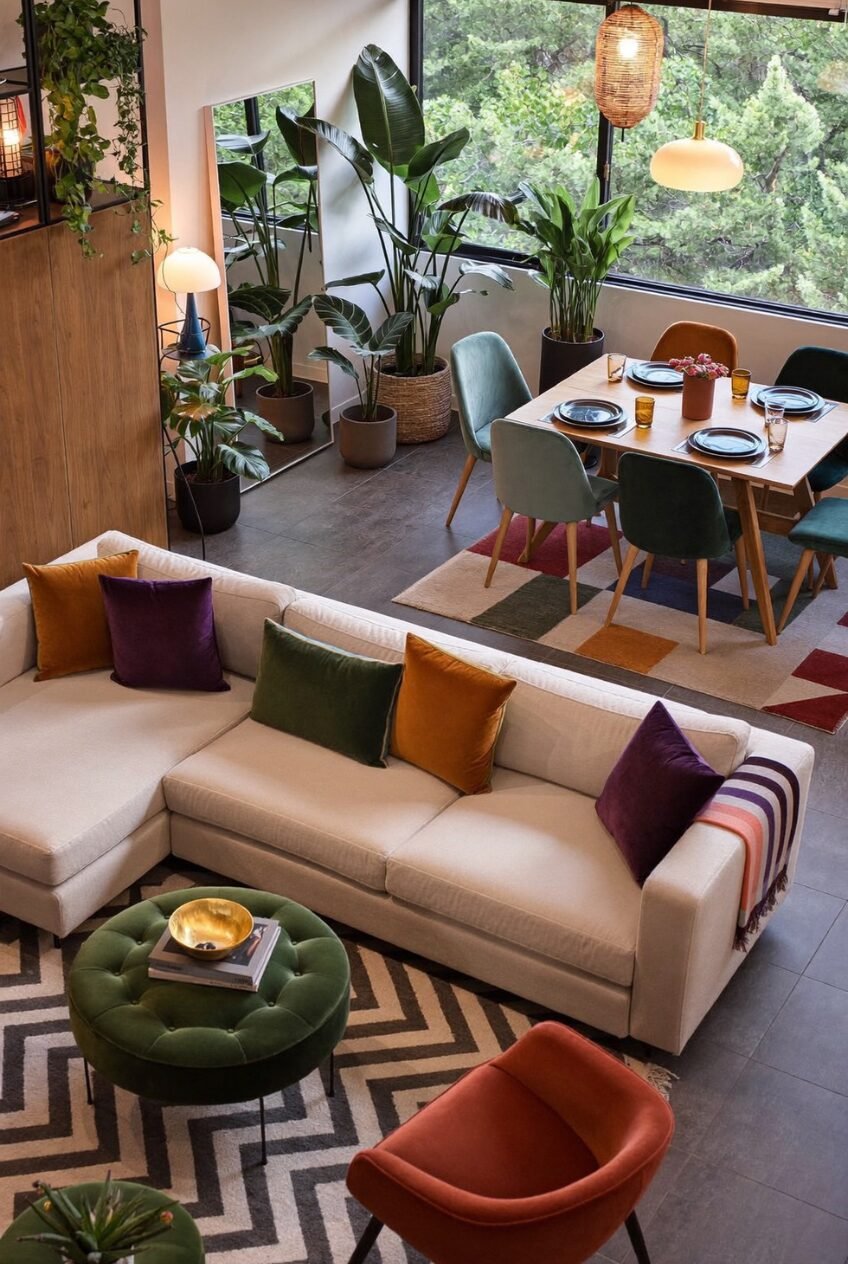
Purple, mustard, and forest green pillows on one neutral sectional shouldn’t really work on paper, but grouping jewel tones together instead of scattering pastel ones is exactly why this combination holds together so well. Stick to deep, saturated shades and skip anything pale if you want this particular look to succeed in a small room.
The geometric rug repeats the same color family underfoot, which is what stops the room from feeling like a pillow display gone wrong. A rug that echoes your accent colors ties a room together faster than any single piece of furniture can. It also gives your eye a place to rest between all that velvet.
Carry the same palette into a nearby dining nook with a mix of green and orange chairs instead of one matching set. Small, open plan apartments read better when one color story runs through every zone rather than each corner doing its own separate thing entirely on its own terms.
Texture Is The Real Star Here
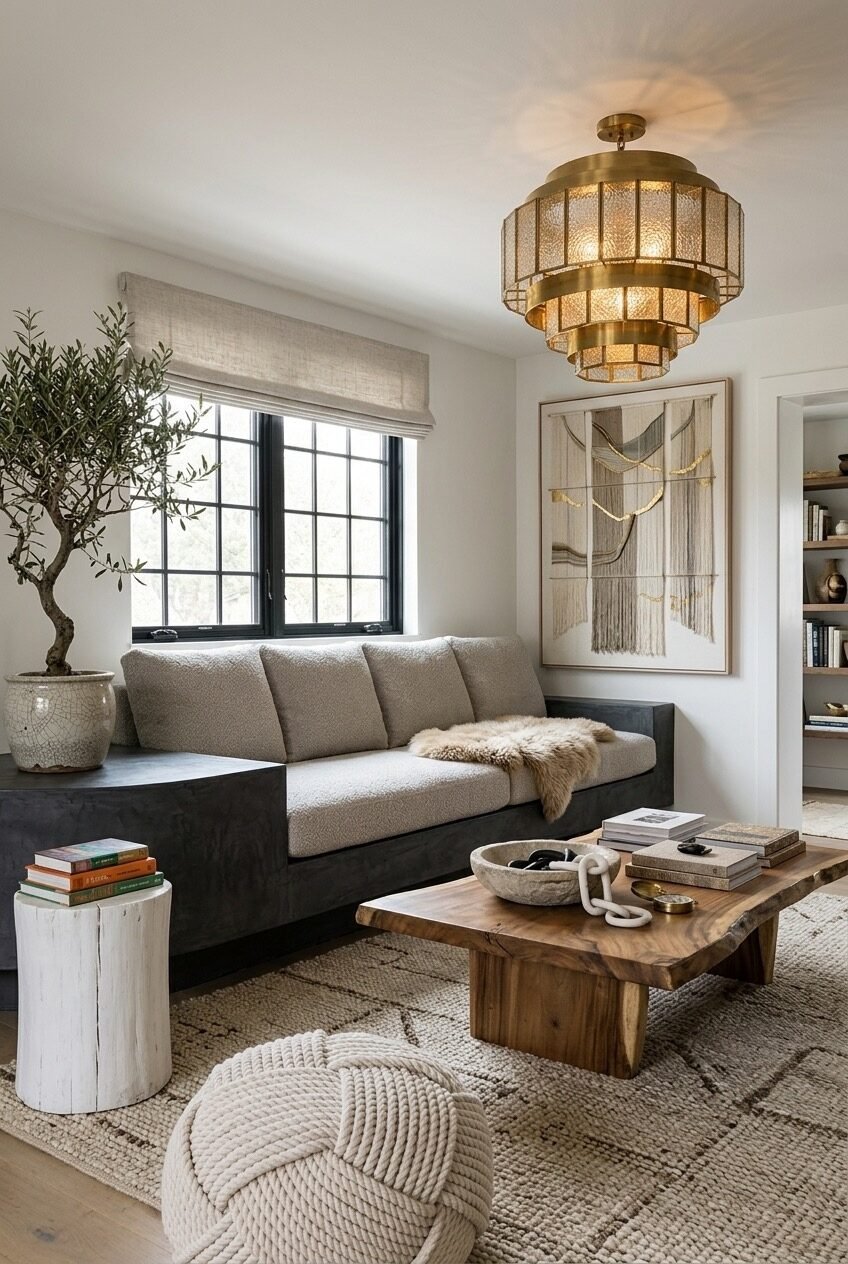
Almost everything in this room is some shade of beige or gray, and yet it never feels flat, because texture is doing all the work color usually does. Boucle cushions, a sheepskin throw, a chunky knotted pouf, and a raw live edge coffee table all sit in roughly the same tonal range but feel completely different to the eye and the hand.
A monochrome room only works if every surface has a different texture. Smooth linen sitting next to rough wood next to nubby boucle keeps a single color space from reading as one flat block.
A small potted olive tree and a tiered brass chandelier add just enough shape and shine to keep things from feeling too quiet. If your apartment already leans neutral, this is the cheapest fix, swap one flat cushion for a textured one and see how much more the room suddenly says.
Your Small Apartment Was Never The Problem
None of the rooms above are large. Some of them are barely bigger than a single generous bedroom, and yet every one of them reads as a full, finished space instead of a compromise. The square footage was never really the obstacle most people assume it is.
What actually separates a small room that works from one that doesn’t usually comes down to a handful of decisions, how the lighting is layered, whether the rug defines a zone, whether color and texture get repeated on purpose instead of scattered at random. None of that costs more money than the alternative, it just asks for a little more thought before you buy anything new.
Pick one idea from this list that matches something you already own, a rug, a lamp, a shelf, and start there instead of trying to overhaul the whole room at once. Small apartments tend to reward patience far more than they reward budget.