
Floating Shelf Designs So Unique Your Living Room Wall Finally Has a Point of View
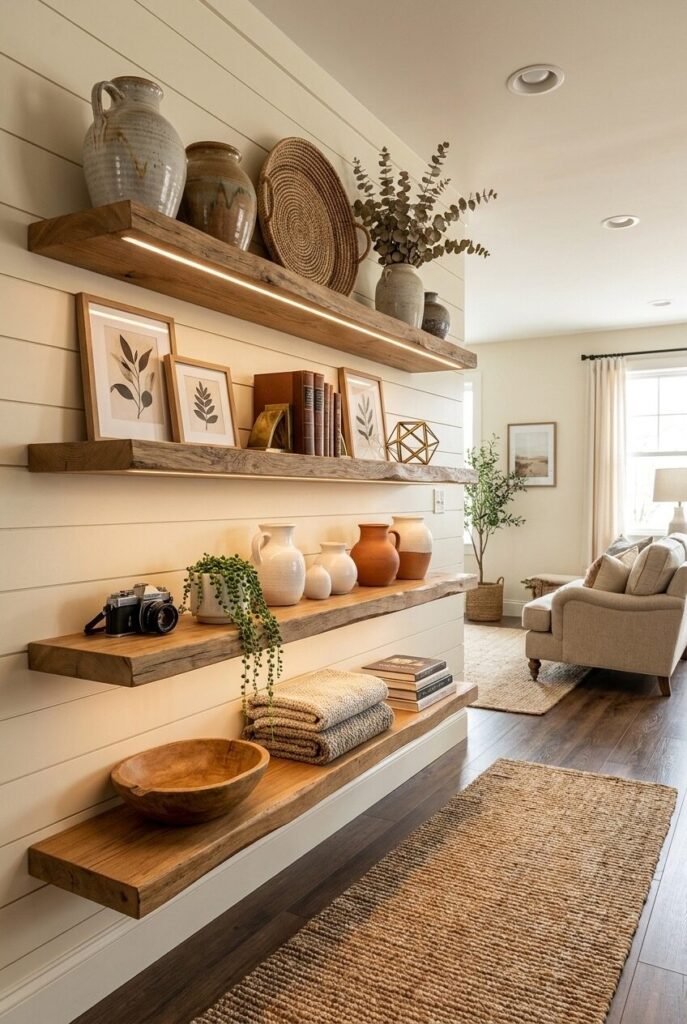
Most floating shelves end up as a place to put things you don’t know where else to put. A candle, a book you finished two years ago, a plant that’s slowly dying — not because shelves are a bad idea, but because the shelf itself rarely gets treated as a design decision. The bracket is an afterthought, the wood is whatever was cheapest, and the styling happens once and never gets revisited.
The shelves worth paying attention to are the ones where the form itself is doing something. Corner units that turn a dead angle into a focal point. Live-edge slabs that make the wall feel geological. Shelves with built-in lighting that changes the entire atmosphere of a room after dark. These aren’t just storage solutions — they’re the kind of wall feature that you’d miss if they were gone.
What follows covers shelf designs across a real range of styles and budgets, with attention to how each one works within a room rather than just on its own. Because a shelf is always in conversation with its surroundings, and that conversation is worth getting right.
Lit Corner Shelves With Fluted Fronts
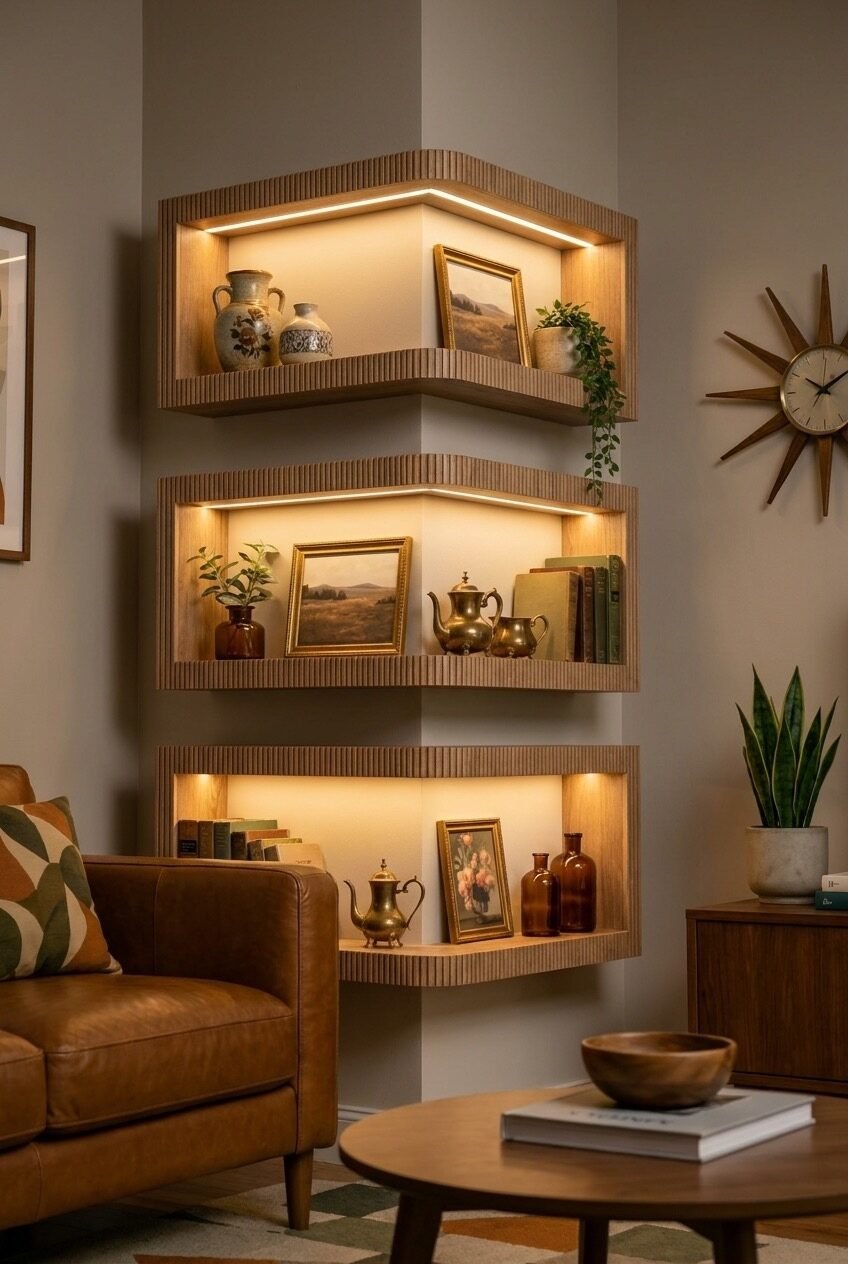
The fluted wood front panel on these corner shelves is doing more work than it might appear. That ribbed texture catches light differently depending on the angle, which means the shelves read as three-dimensional even from across the room — they’re not flat boxes attached to a wall, they’re objects with their own presence. The wraparound corner format is the real structural decision here: by spanning both walls continuously, the unit commands the corner rather than just occupying it.
Built-in LED strip lighting running along the back of each shelf tier is what makes this setup work after dark. The warm-toned glow pools on the shelf surface and highlights objects from behind, which is fundamentally different from overhead lighting — it creates depth rather than just illumination. Amber glass bottles, framed landscape prints, and a brass tea set all read as intentional display pieces rather than random objects because the lighting frames them.
For a DIY or semi-custom version, the key investment is in the corner-spanning construction — shelves that only go to the wall edge instead of wrapping lose the effect entirely. The fluted front panels can be achieved with MDF routed in a workshop or purchased as decorative moulding strips applied over a plain shelf face. Pair the warm LED temperature (around 2700K) with brass and amber objects to keep the whole composition cohesive.
Arch-Framed Plant Shelves With Rattan Backs
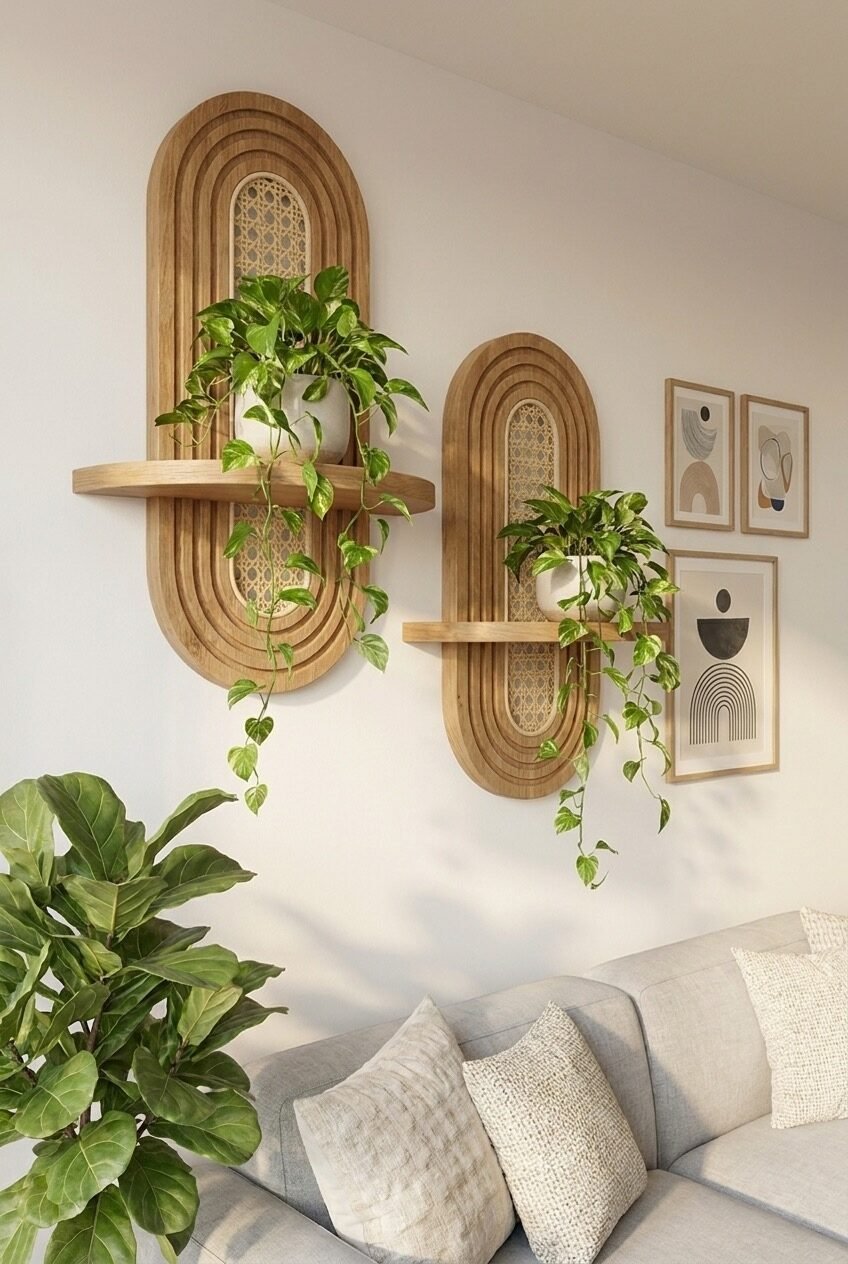
Put a trailing pothos in a white ceramic pot, mount it on a shelf that sits inside a layered wood arch with a rattan cane backing, and suddenly a plain wall has a composition worth looking at. The arch frame here acts as a picture frame for the plant — it gives the greenery a defined boundary, which paradoxically makes the trailing vines feel more expressive because they’re spilling out of something rather than just hanging in open space.
The rattan cane back panel is the detail that pushes these from interesting to genuinely well-considered. It introduces a second natural texture behind the wood and adds visual warmth to what would otherwise be a flat white wall. The layered arch profile — multiple concentric outlines in decreasing size — borrows directly from architectural detailing and gives the pieces a crafted quality that flat-cut shelves can’t match.
These are best used in pairs or small groupings rather than as a single statement piece, as shown here. Stagger them slightly in height rather than aligning them perfectly — perfect alignment makes them look like a product display, while slight variation looks like someone made a deliberate arrangement decision. Style exclusively with trailing or cascading plants rather than upright ones; the arch is designed to frame overflow, and an upright plant inside it just looks contained.
Branch Bracket Shelves Above a Sofa
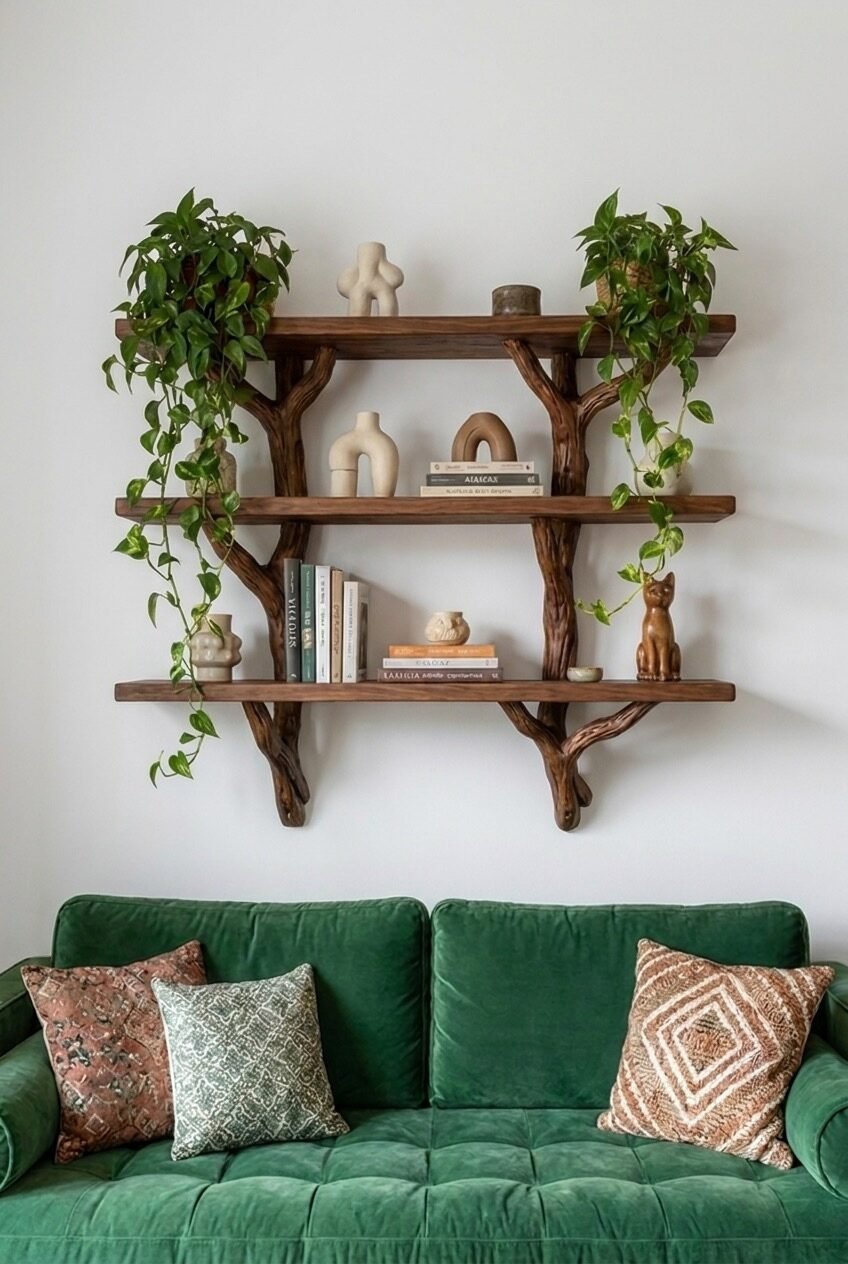
The branching wood supports here are not brackets pretending to be branches — they’re carved or cast to convincingly mimic the kind of forked limb structure you’d actually find on a tree. That specificity matters. Decorative pieces that gesture at nature without committing tend to look like props; these commit fully, and the result is something that reads more like furniture than shelving hardware.
Over a green velvet sofa, the warm dark brown of the carved branches and shelf boards creates a complementary contrast — the deep jewel tone of the upholstery and the earthy wood occupy different points on the natural spectrum without fighting each other. Trailing pothos plants at both ends of the top shelf reinforce the organic theme without overdoing it. The ceramic objects in the center — matte abstract sculptural forms in cream and sand — keep the styling from feeling too themed.
The practical challenge with branch-style brackets is weight distribution: because the support points are not vertical, heavy objects should be centered on the shelf rather than placed at the ends. Look for designs where the branch forms create a genuine triangulated support structure rather than purely decorative carved panels. For the styling, resist the urge to add more natural references — one or two plants plus neutral ceramics is enough. Stacking books horizontally at the lower tier gives visual weight without competing with the structural drama above.
Mixed Shelf Formats Around a Mounted TV
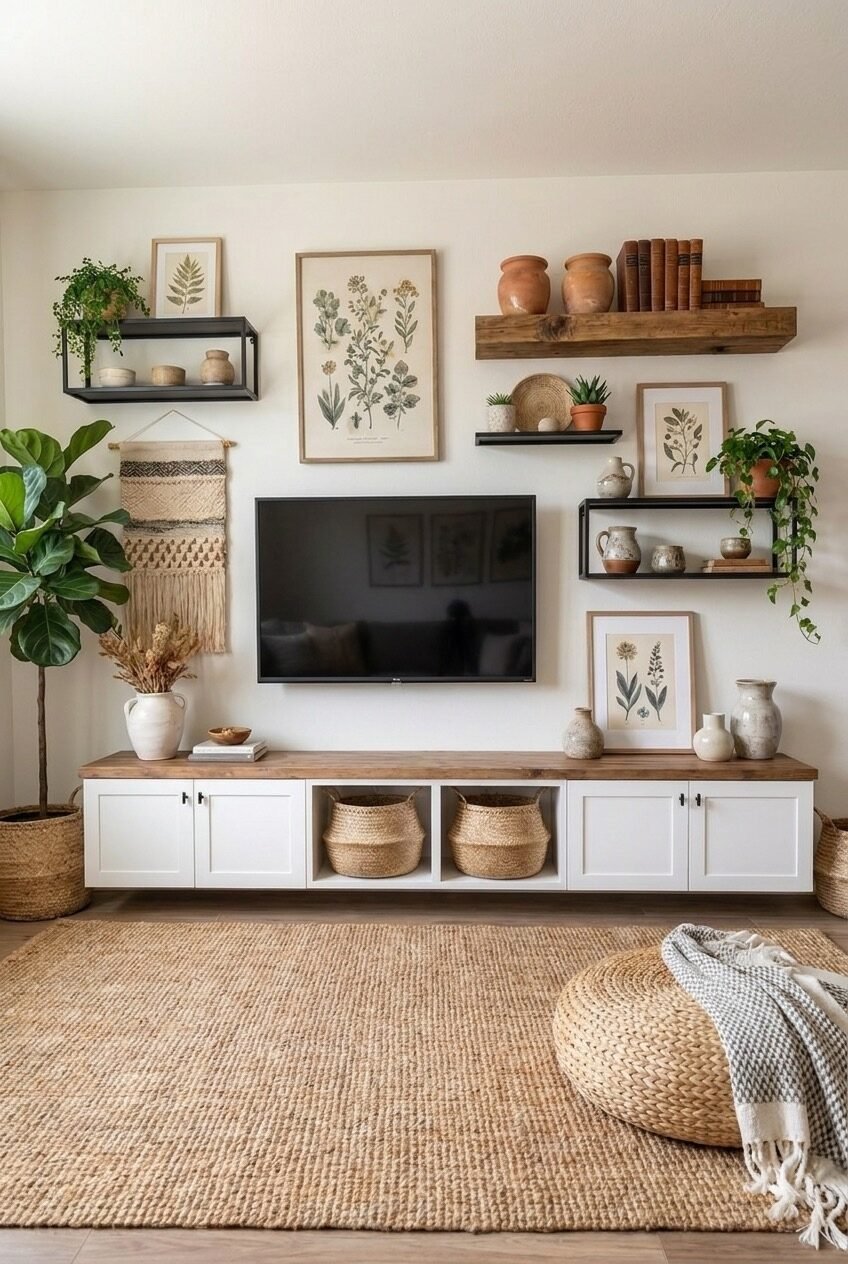
Start with the gallery wall instinct and then give some of those frames legs — that’s essentially what’s happening here. A combination of black metal box shelves, raw wood floating shelves, and framed botanical prints are arranged asymmetrically around a wall-mounted TV, creating a composition where the screen sits within a larger styled arrangement rather than dominating a blank wall.
The material contrast between the black metal box shelves and the chunky reclaimed wood plank shelf is what keeps the arrangement from feeling too coordinated. Each shelf type has a distinct character — the metal boxes are structured and graphic, the wood plank is organic and rough — and the visual tension between them is exactly what makes the whole wall feel alive. A matching set of identical shelves in this configuration would look like a kit rather than a collection.
The botanical print hung directly on the wall between shelves is doing crucial compositional work — it fills vertical space that shelves can’t reach while staying within the same natural-material aesthetic as the shelf styling. For anyone building a similar TV wall, the principle to follow is: treat the TV as one element in a composition, not as the thing the composition is built around. Anchor the TV to one side of the wall arrangement rather than centering it, and let the shelves and prints expand into the remaining space without mirroring.
Hexagonal Corner Shelves With Backlit Interiors
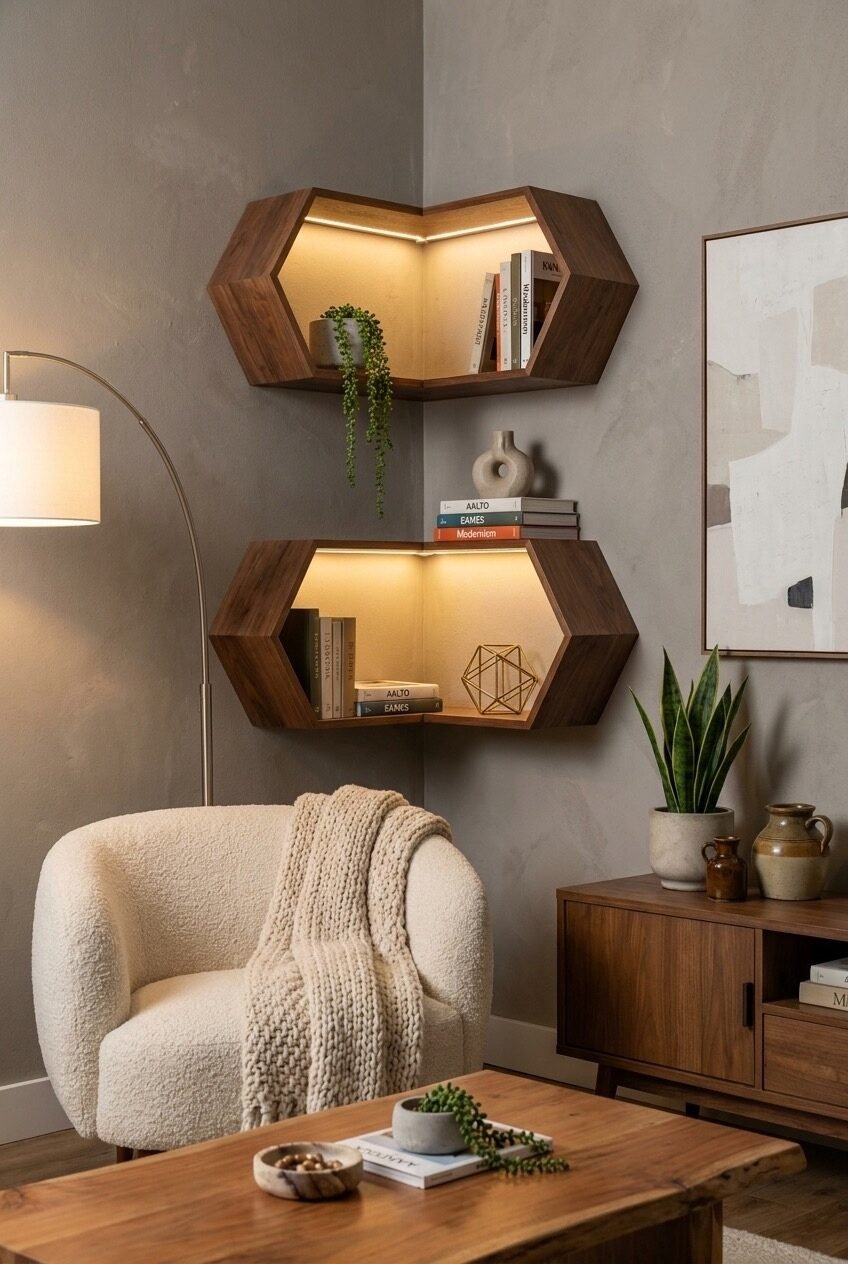
Two hexagonal walnut shelves, each spanning a corner and fitted with warm LED strips along the back edge — this is the kind of shelf design that needs no styling to make an impact, and the styling here wisely keeps it simple. A few stacked design books on top, a trailing string-of-pearls plant, a geometric brass ornament, and a small framed print. Nothing is competing with the form of the shelf itself.
The hexagonal silhouette is genuinely unusual for corner shelving, which typically goes square or triangular. The angled faces of the hexagon catch light at different planes depending on where you’re standing, which gives the unit a sculptural quality that flat-cornered alternatives don’t have. In a room with primarily rectangular furniture — sofa, coffee table, console — the hexagonal shelves introduce the only curved-angle geometry, and that contrast is precisely what makes them stand out.
Walnut is the right material choice for this design because its warm brown tone keeps the angular form from feeling cold or industrial. If full walnut is out of budget, walnut veneer over MDF achieves a near-identical visual result at significantly lower cost. The built-in LED strips should run along the full depth of the back wall inside the shelf, not just the top edge — full-depth lighting creates an even glow pool rather than a bright line.
Single Tree-Branch Corner Floor Unit
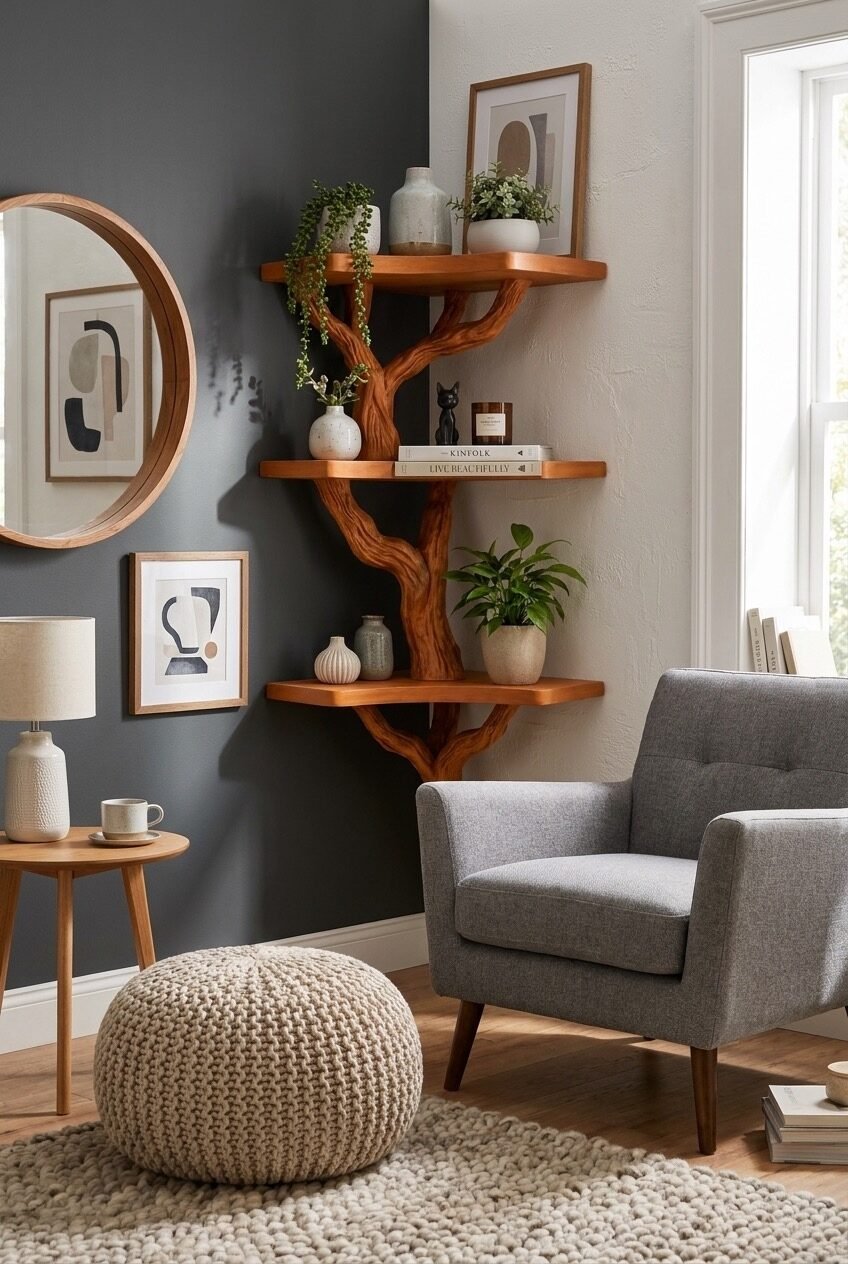
Unlike the wall-mounted branch shelves, this design routes a single carved trunk-form up a corner from near floor level to ceiling height, with three individual shelf arms extending outward at different heights. It occupies far less floor footprint than a bookcase while claiming the full vertical height of the corner — which is a genuinely smart spatial trade.
The contrast with the dark grey-blue accent wall behind it is striking: the rich amber tone of the carved wood reads almost warm against the cool, deep painted surface, creating a natural vs. architectural tension that spaces like this tend to feel charged with. The shelves themselves are kept deliberately minimal — a few ceramic vases, one plant, a stack of books with a candle — because the trunk form is already doing considerable visual work and doesn’t need to compete with heavily loaded surfaces.
The key design principle here is that this piece belongs at the point where two different wall treatments meet — in this case where the dark accent wall transitions to a lighter side wall. Placing it in the corner at that junction means it bridges the two surfaces rather than belonging entirely to either one. For anyone considering a similar piece, look for artisan woodworkers who use actual wood carving rather than resin casting — the texture reads entirely differently in person, and the weight of real carved wood keeps the structure more stable.
Live-Edge Reclaimed Wood Around a Stone Fireplace
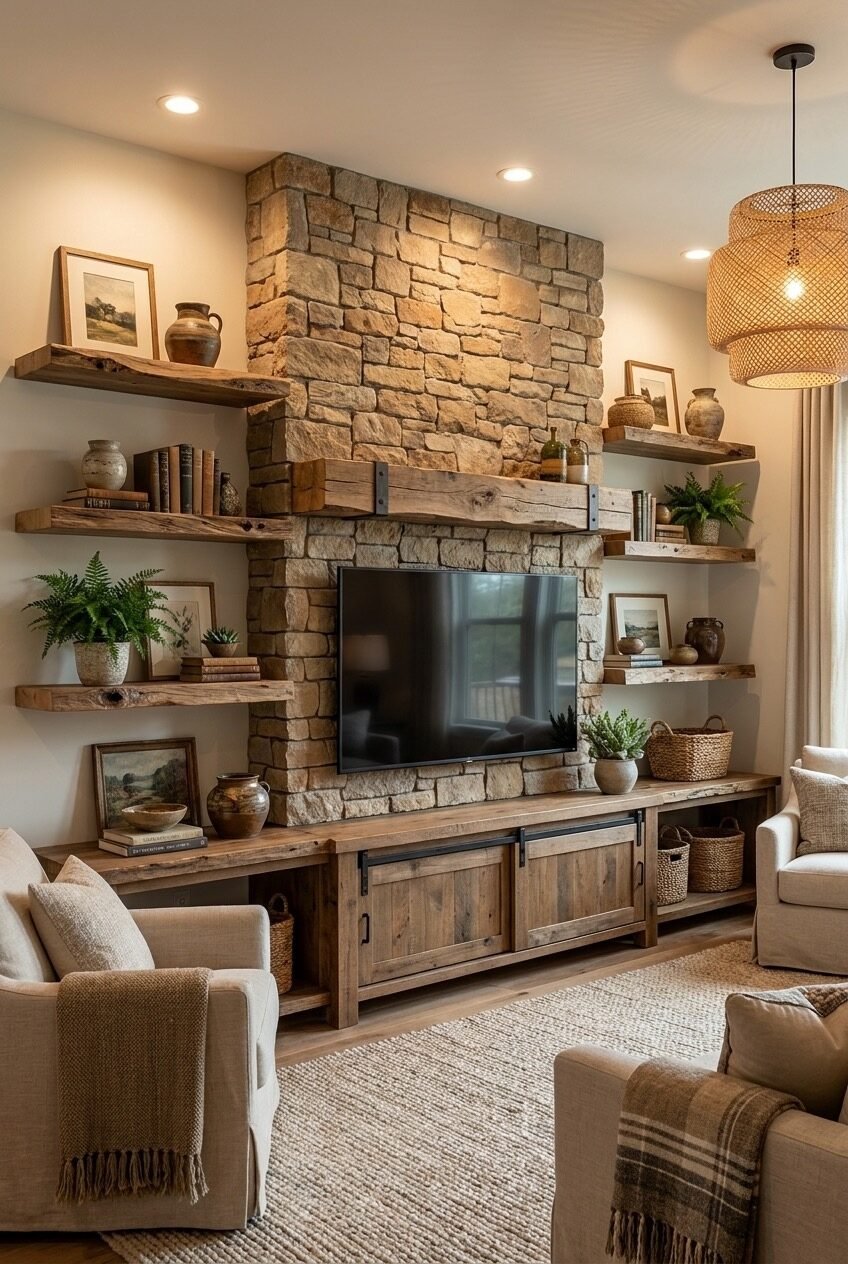
Raw reclaimed wood beams mounted directly on plaster walls flanking a floor-to-ceiling stacked-stone fireplace — this is a room that committed to a material story and followed it through without wavering. The live-edge character of the shelf boards, with their natural bark inclusions and irregular grain patterns, echoes the rough-hewn texture of the stone. Neither surface is trying to be refined, and that consistency is what makes the whole wall feel intentional without actually being precious about it.
Styling on these shelves leans entirely into earth tones: ceramic vessels, leather-bound books, wicker baskets, fern plants in terracotta pots. There’s no chrome, no white, no high-gloss surface anywhere in the composition. That strict material discipline is what allows the natural textures to be the visual event — introduce one shiny or synthetic element and the whole thing starts looking like a set rather than a room.
The floating shelf installation around a stone fireplace requires more planning than a standard drywall mount. The shelves here are anchored into the plaster wall sections beside the stone, not into the stone itself — stone anchoring is possible but requires masonry bits and toggle bolts rated for the load. Reclaimed wood shelves of this depth and density are heavy; use hidden shelf brackets rated for at least double the anticipated load, and have a second person assist with leveling during installation.
Rounded-Edge Bent Plywood Shelf Units
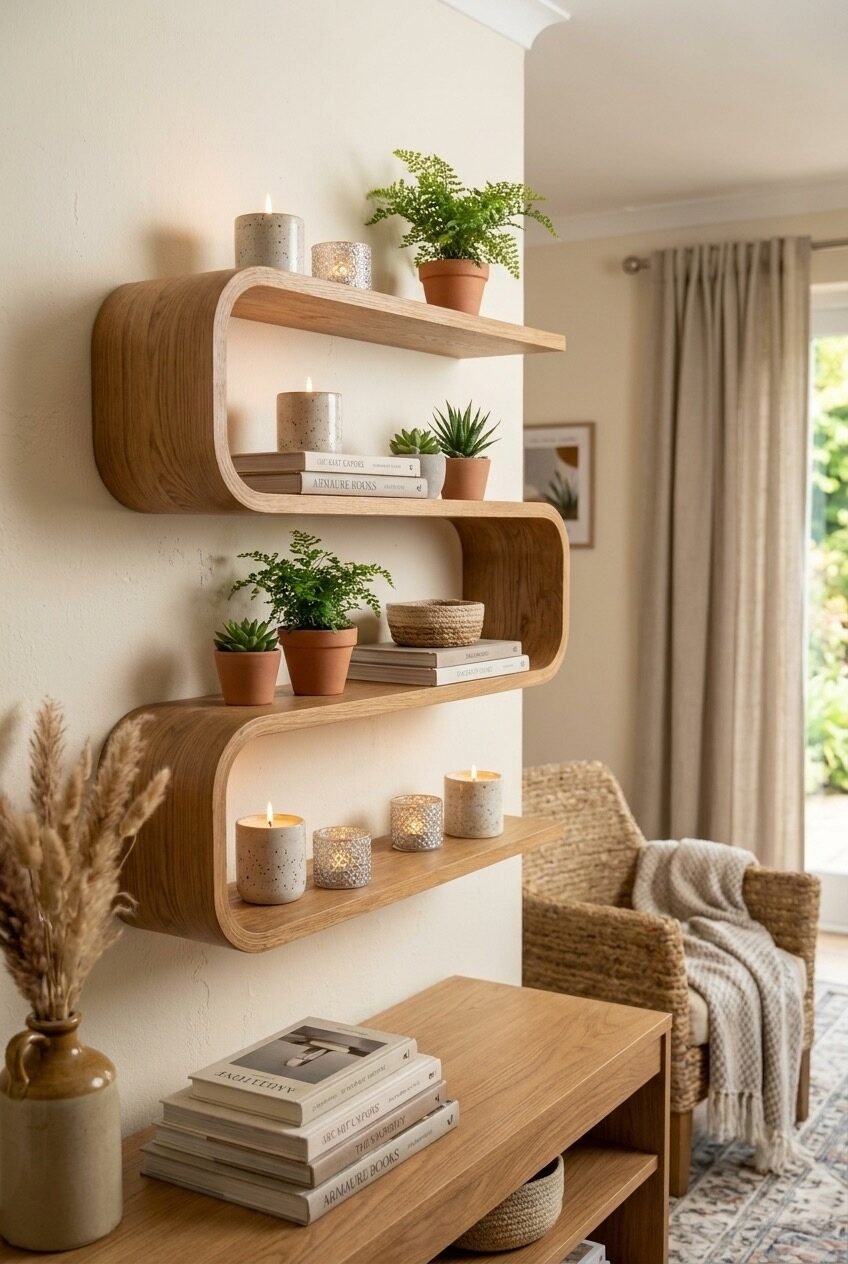
The fully rounded corners on these shelf units — not just softened edges but complete curves at the top and bottom of each side panel — give them a quality that’s hard to describe precisely but easy to feel. They look like they’ve been folded from a single piece of material. There’s no sharp angle anywhere in the design, which makes them unusually calm to look at in a room full of right angles.
Small terracotta pots with succulents and ferns, a few candles, and stacked books in muted covers — the styling is deliberately unhurried, which suits the form. Rounded furniture tends to read as softer and more residential than its angular counterparts, and the objects placed on these shelves reinforce that quality rather than working against it. A geometric brass object or a hard-edged book stack would introduce visual tension that the shelf form isn’t inviting.
Bent plywood or bent laminate construction is the most common way to achieve this fully rounded silhouette. For a DIY approach, it’s technically demanding — achieving consistent curves requires either a vacuum press or purpose-built bending forms. The more accessible route is sourcing ready-made shelf units from manufacturers who specialize in this form, then mounting them with concealed hardware so the rounded sides remain the visual focus. Natural oak veneer, as used here, is the right surface choice because it reinforces the organic character of the rounded form without going too rustic.
L-Shaped Corner Shelves With Iron Brackets
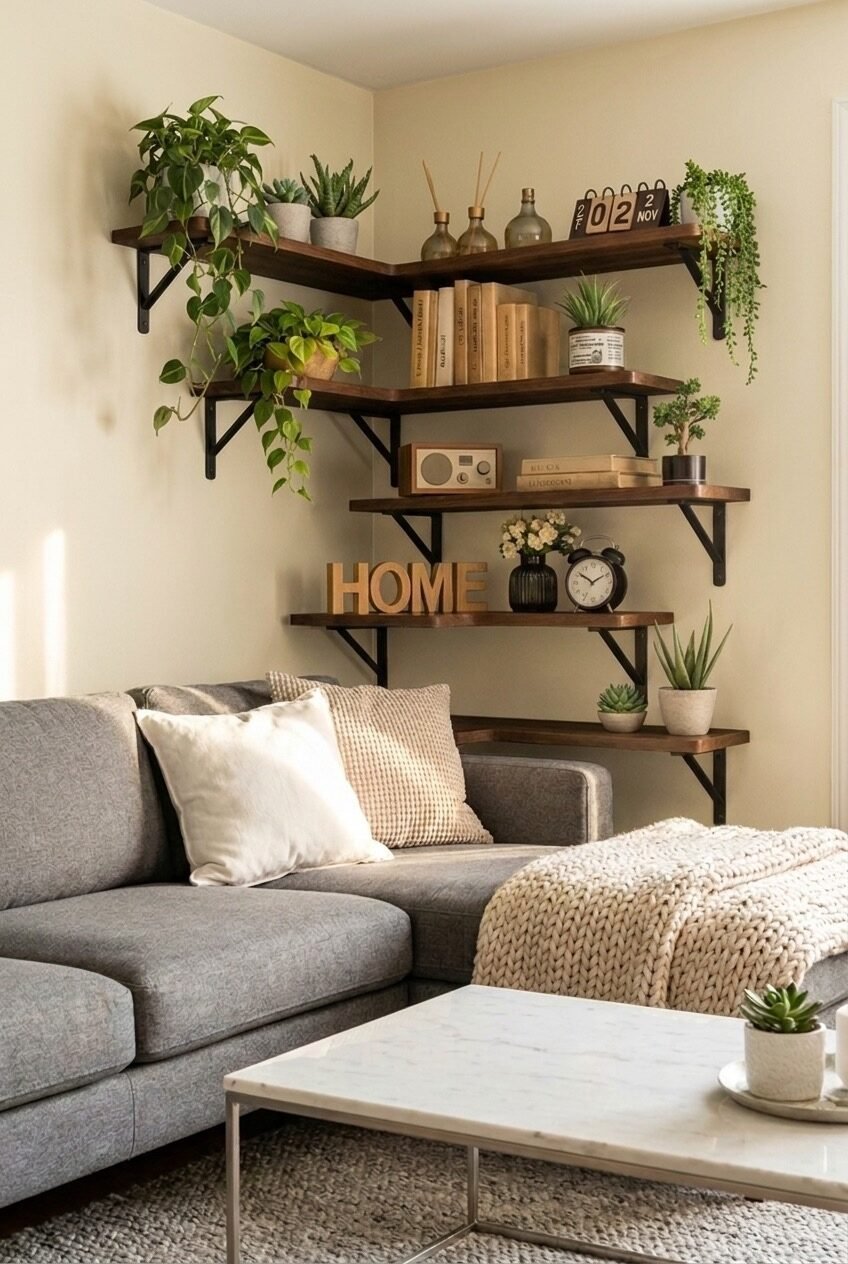
Five shelves wrapping a corner with visible black iron angle brackets — this is the arrangement that looks like the owner bought the shelves at a hardware store and figured out where to put them afterward, and somehow ended up with something genuinely good. That’s not an accident. The dark stained wood boards, the simple exposed bracket hardware, and the warm cream wall color are each individually unremarkable, but together they create a backdrop that makes almost any collection of objects look considered.
The styling across these shelves is what most people actually need a template for: plants of varying sizes and leaf types anchoring the ends of upper shelves, books grouped by spine color in the middle tiers, small objects like a vintage radio and a flip calendar providing specific personality without overwhelming the composition. The corner wrap-around is crucial — it means the shelves are read as a single installation rather than two separate walls of shelves, which gives the arrangement a scale it wouldn’t otherwise have.
For anyone replicating a corner shelf arrangement like this, the most common mistake is inconsistent bracket placement — brackets that don’t align vertically between shelves make the installation look improvised rather than placed. Use a level and a plumb line before drilling, mark all bracket positions on both walls before installing any of them, and maintain equal vertical spacing between shelves throughout. The bracket itself is a visible element here, so choose one with a clean forged or cast profile rather than the thinnest available option.
Live-Edge Slabs on a Concrete Feature Wall
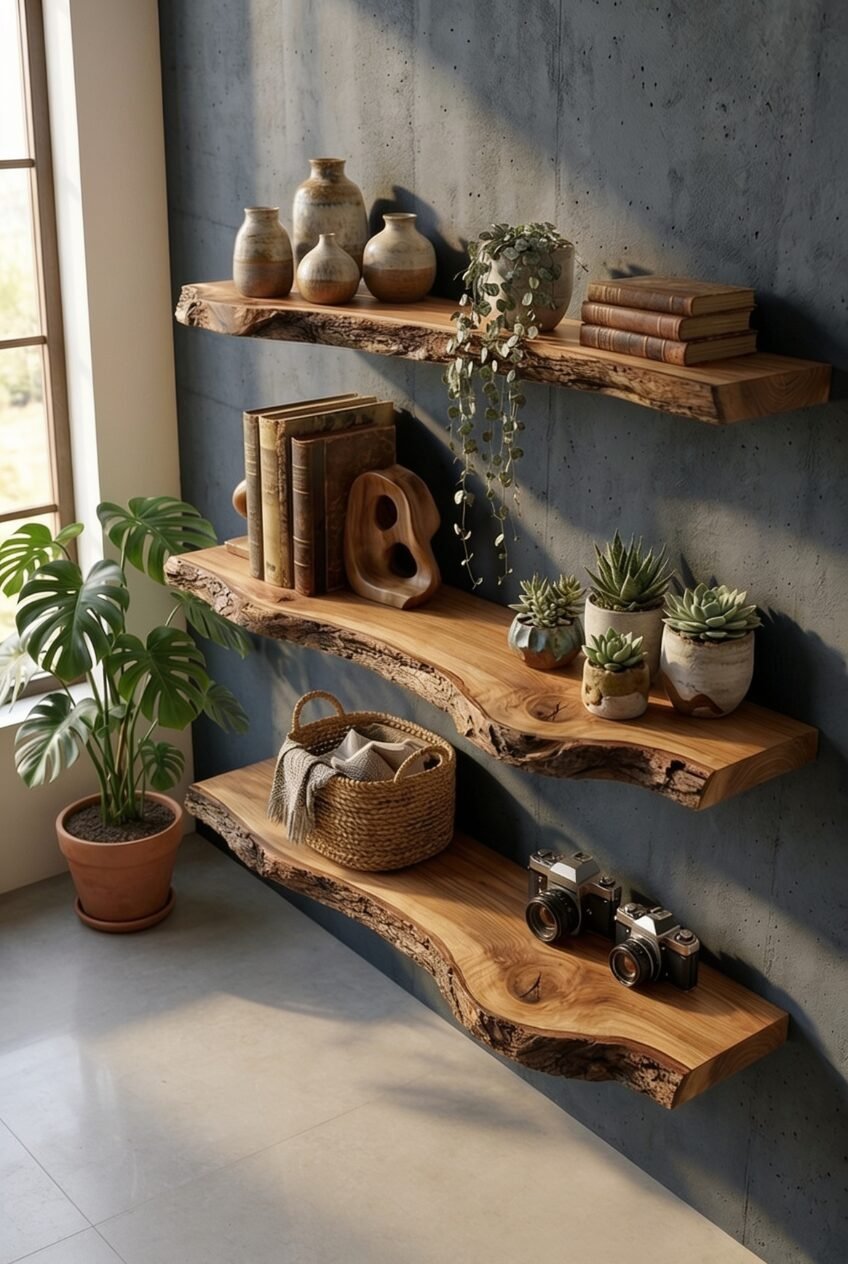
Three live-edge wood slabs mounted in a descending staircase arrangement against a raw concrete wall — this is a pairing that works because both materials are genuinely unprocessed. The concrete has its aggregate texture and form lines visible; the wood has its original bark edge and natural grain irregularities. Neither surface is pretending to be something else, and the result is a wall that feels more like a geological cross-section than a decorated room.
The staggered descending arrangement is worth examining more closely. Rather than mounting the shelves at uniform heights across the full wall width, each shelf is set slightly lower and shorter than the one above, creating a diagonal reading line from upper left to lower right. This stepped configuration means the shelves work as a composition before a single object is placed on them — the arrangement itself has movement and direction.
Sourcing genuine live-edge slabs requires a timber yard or specialty wood supplier rather than a home improvement store. Look for slabs with intact natural edges on at least one side, and avoid pieces where the live edge has been sealed with thick epoxy that makes it look plastic. For mounting, use concealed floating shelf hardware sized for the slab thickness — live-edge pieces often vary in depth, so measure at the thickest point and select brackets accordingly. Style these shelves with natural objects that echo the raw quality of the wood and wall: handmade ceramics, wicker baskets, books without dust jackets.
The Right Shelf Changes What a Room Is Capable Of
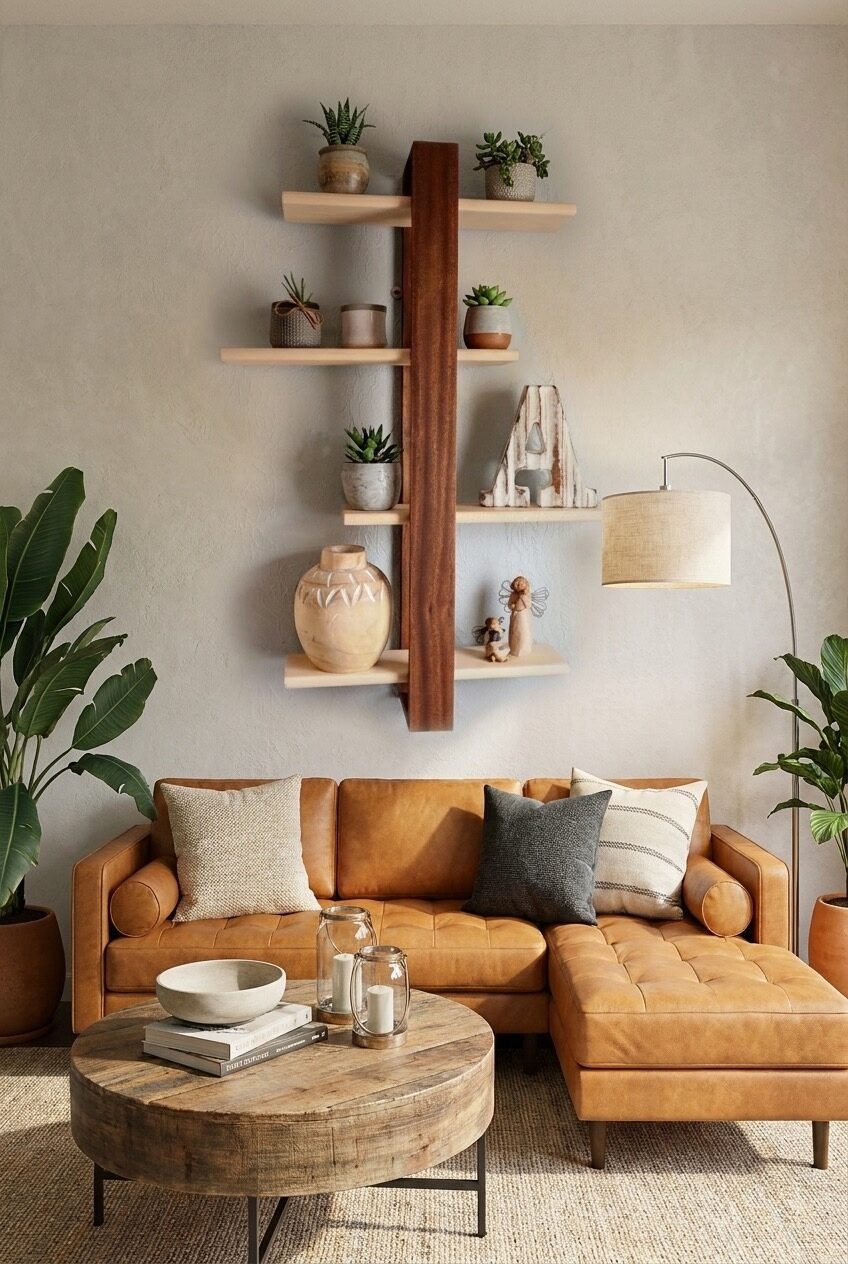
A shelf that fits the room it’s in — really fits, not just physically but in material and character — does something that most wall decor can’t: it becomes part of the architecture. The live-edge slab against concrete, the lit hexagonal corner unit, the branching carved wood rising toward the ceiling — none of those read as things that were added to a room. They read as things the room was designed around.
That quality is achievable without a custom build budget or a renovation. It requires paying attention to the relationship between the shelf material and the wall surface, between the shelf form and the existing furniture geometry, and between the shelf’s visual weight and the scale of the room. Get those three relationships right and almost any shelf design can land well.
The styling part, which tends to get the most attention, matters less than the structural decisions. A well-chosen shelf styled simply will almost always outperform an ordinary shelf over-decorated in an attempt to compensate. Start with the form, then let the objects follow.