
What Actually Makes A Kitchen Feel Like Christmas Beyond The Usual Garland
Every other room in the house gets decorated for show, but the kitchen is the one that actually gets used on Christmas morning. Someone’s leaning against the counter with coffee, someone’s stirring something on the stove, and someone’s standing in the doorway asking if breakfast is almost ready. That’s the room worth dressing up first.
We’re not talking about one garland over the sink and calling it finished. Kitchens that feel genuinely festive spread small details across every surface, the open shelf, the stovetop, the corner nobody usually bothers with, so the whole room carries the mood instead of one single wall doing all the work.
What follows are kitchens that got this right, each one leaning into a different mood, palette, and level of commitment. Borrow whichever pieces match your own space and skip the ones that don’t. Decorating a room you actually cook and eat in should feel personal, not prescribed.
Open Shelves Do The Heavy Lifting
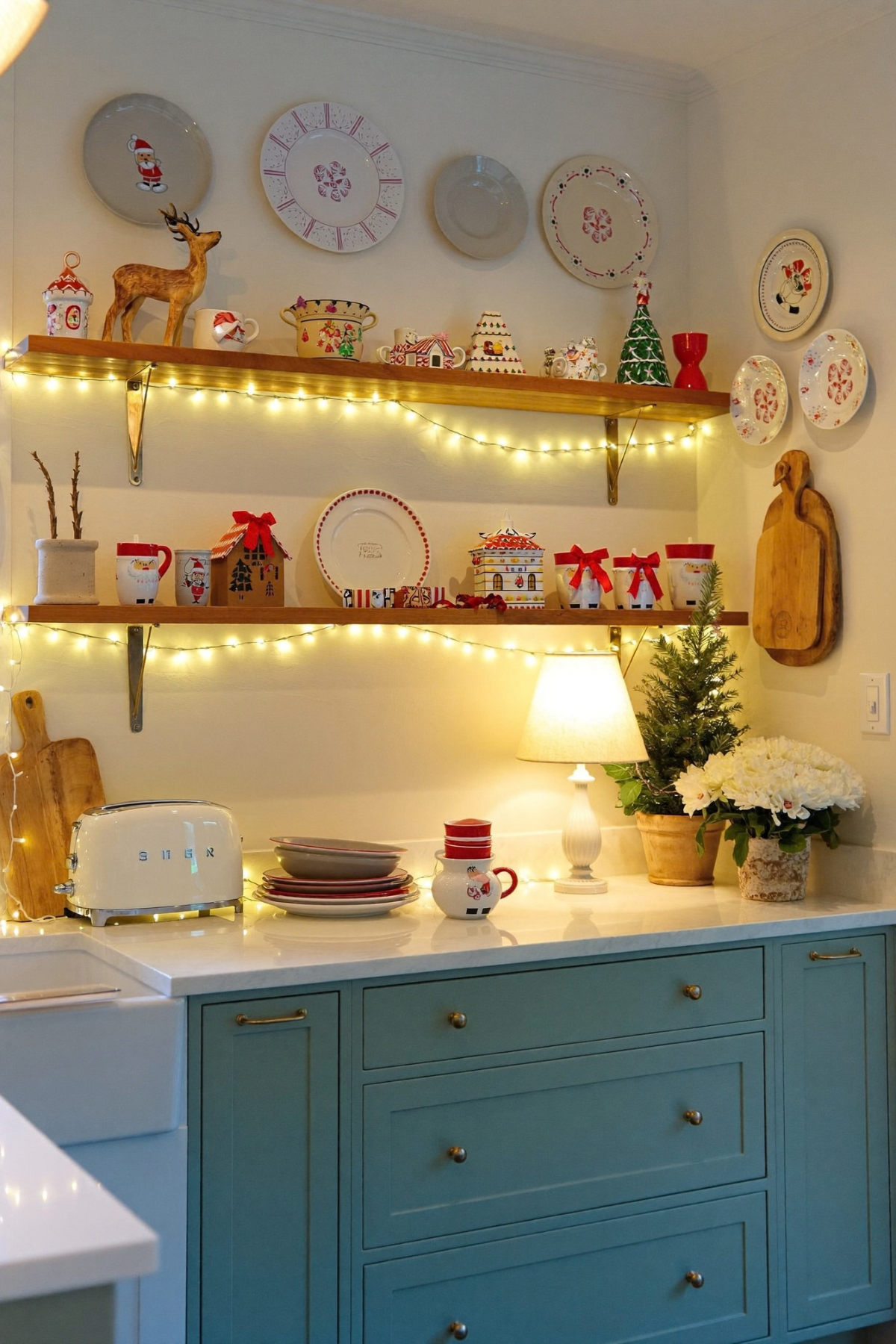
Open shelving gets treated like a storage problem most of the year, and then Christmas comes along and turns it into the best display case in the house. Layer plates standing upright at the back, mugs and small figurines in front, and let a wooden deer or a ceramic house break up the row so your eye has somewhere to land.
String lights are doing more work in this kitchen than any single ornament. Tucked along the underside of the shelf rather than draped across the front, they throw a warm glow down onto the counter without turning the whole wall into a light display. That low, hidden placement is the difference between festive and gaudy.
If your cabinets already lean into a bold color like this teal, don’t fight it, let the red and cream Christmas pieces sit against it instead of trying to match. A small potted tree and a few white blooms at the end of the counter soften all that pattern and keep the corner from feeling like a display shelf at a holiday market.
Turn The Island Into A Buffet
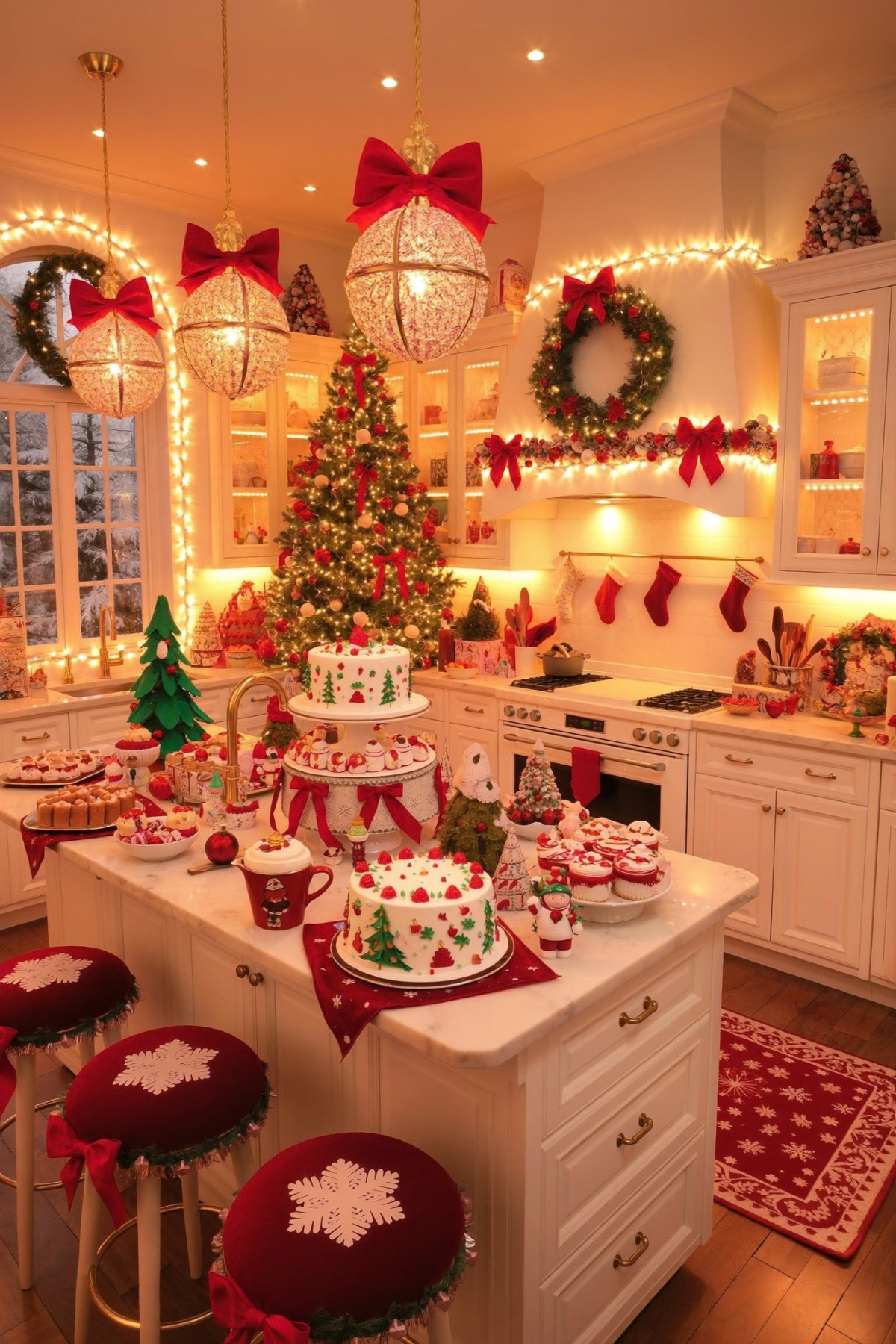
An island this size is basically begging to be used as a dessert table once a year, and honestly, why not. Stack a cake on a pedestal in the center, ring it with smaller plates of cupcakes and bite-sized treats, and let the whole surface read like a bakery counter instead of a spot to chop vegetables.
Scale is what makes this room memorable. Those oversized ornament pendants hanging over the island are doing the job a chandelier normally would, and they only work because nothing else in the room is competing for that same visual weight. Pick one dramatic element per room and let everything else stay smaller.
Velvet stool covers with snowflake appliques are a low-effort swap that changes the whole feel of a seating area in minutes. Slipcovers over your existing stools cost far less than new furniture and come off just as fast come January. Stick to one or two accent colors across the stockings, ribbons, and rug so the red doesn’t fight itself.
Build A Village On Your Counter
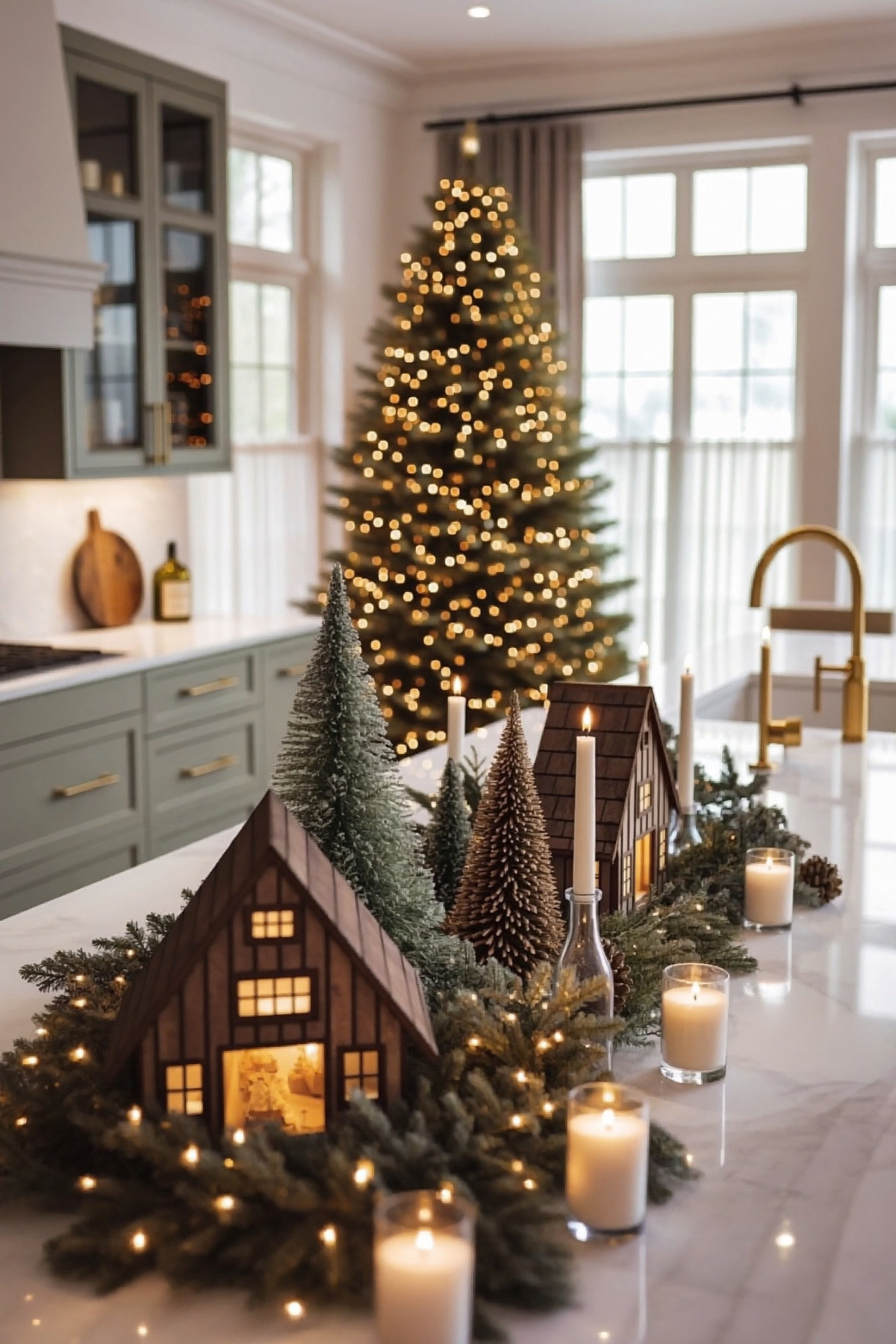
There’s a whole genre of Christmas decor that has nothing to do with garland or ribbon, and it’s this: little wooden houses with candlelit windows, clustered with bottlebrush trees along a runner of fresh pine. It’s closer to setting a scene than decorating a shelf, and it rewards patience over budget.
Keep the pieces at varying heights so the village reads like an actual street rather than a straight line of identical objects. Two houses, three or four trees in different sizes, and a scatter of real greenery underneath is enough. Tealight candles tucked between the trees add flicker without needing an outlet anywhere near the counter.
The blurred Christmas tree glowing behind this whole setup isn’t an accident, it’s what makes the foreground feel intimate rather than staged. A single string of warm white lights on a tree a few feet back does more for the mood of a photo than another decoration on the counter itself. Sage cabinetry and brass fixtures keep the palette from tipping into full-on candy cane territory.
Give Hot Cocoa Its Own Corner
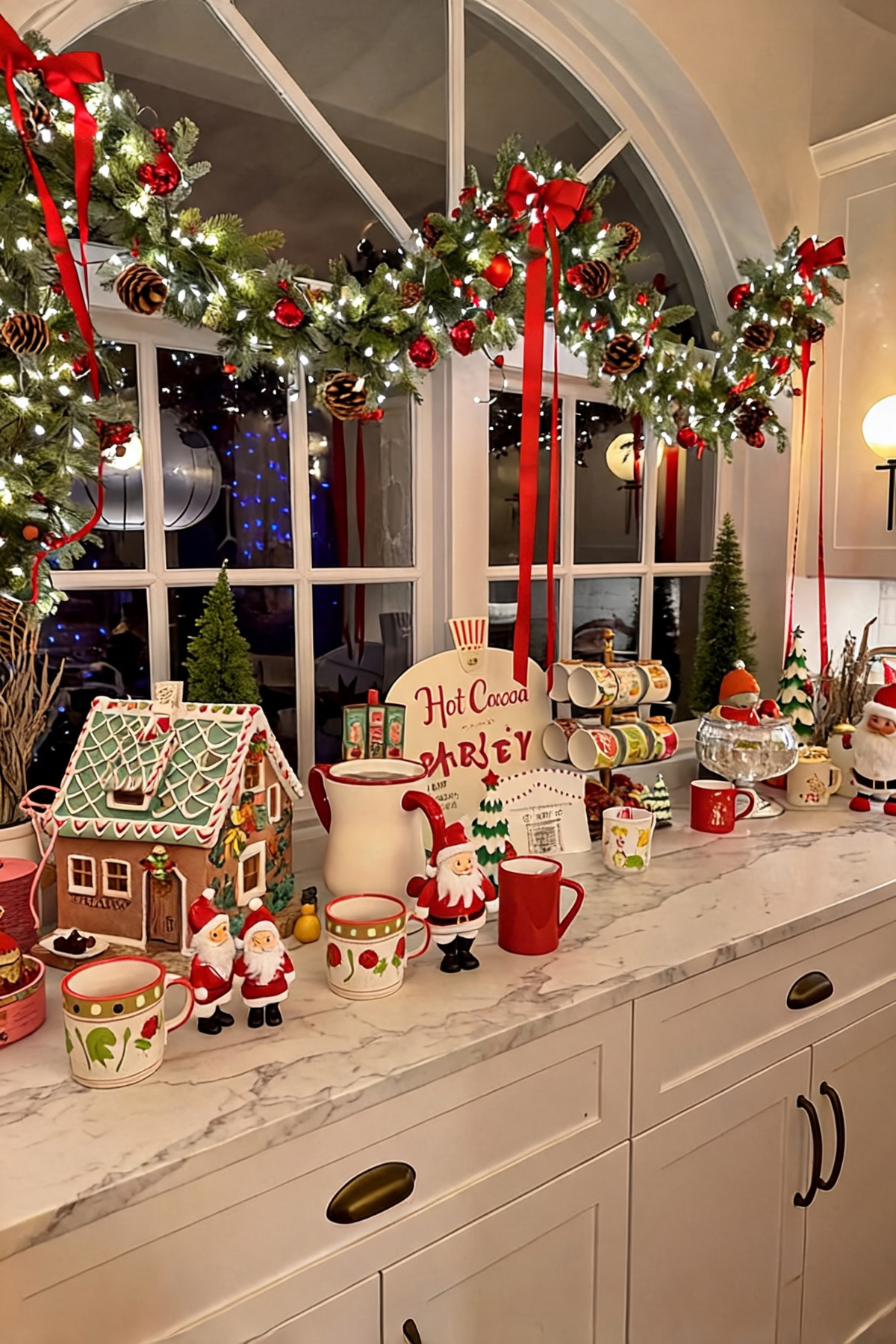
A dedicated hot cocoa station only works if it feels stocked rather than staged, and this corner nails that by leaning into volume. A cream pitcher, a row of mismatched mugs, a stack of cocoa packets in a little rack, and a sign that actually says what the corner is for so guests don’t have to ask.
Vintage santa figurines do a lot of quiet heavy lifting here. They’re small, they’re cheap to collect over the years, and grouping several together in slightly different styles reads as a deliberate collection instead of clutter. Look for them at thrift stores rather than buying a matching set new.
Hang whatever garland you’re using low enough that the ribbon tails actually brush the counter, not up near the ceiling where it disappears into shadow. That lower placement is what gives this whole nook its layered, lived-in look instead of feeling like decor bolted on above eye level. A gingerbread house nearby ties the sweet theme together without needing another sign.
Let One Pattern Repeat Three Times
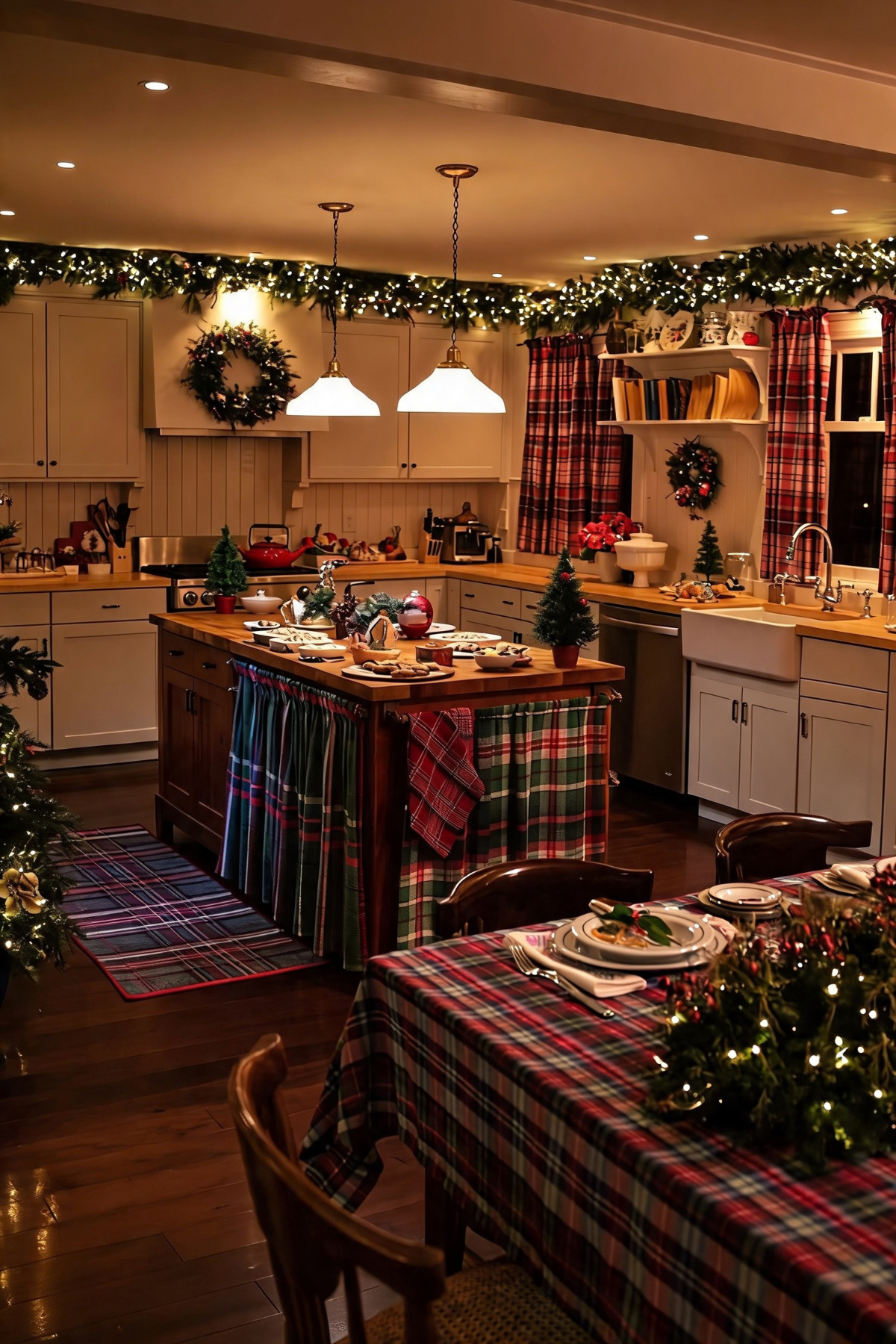
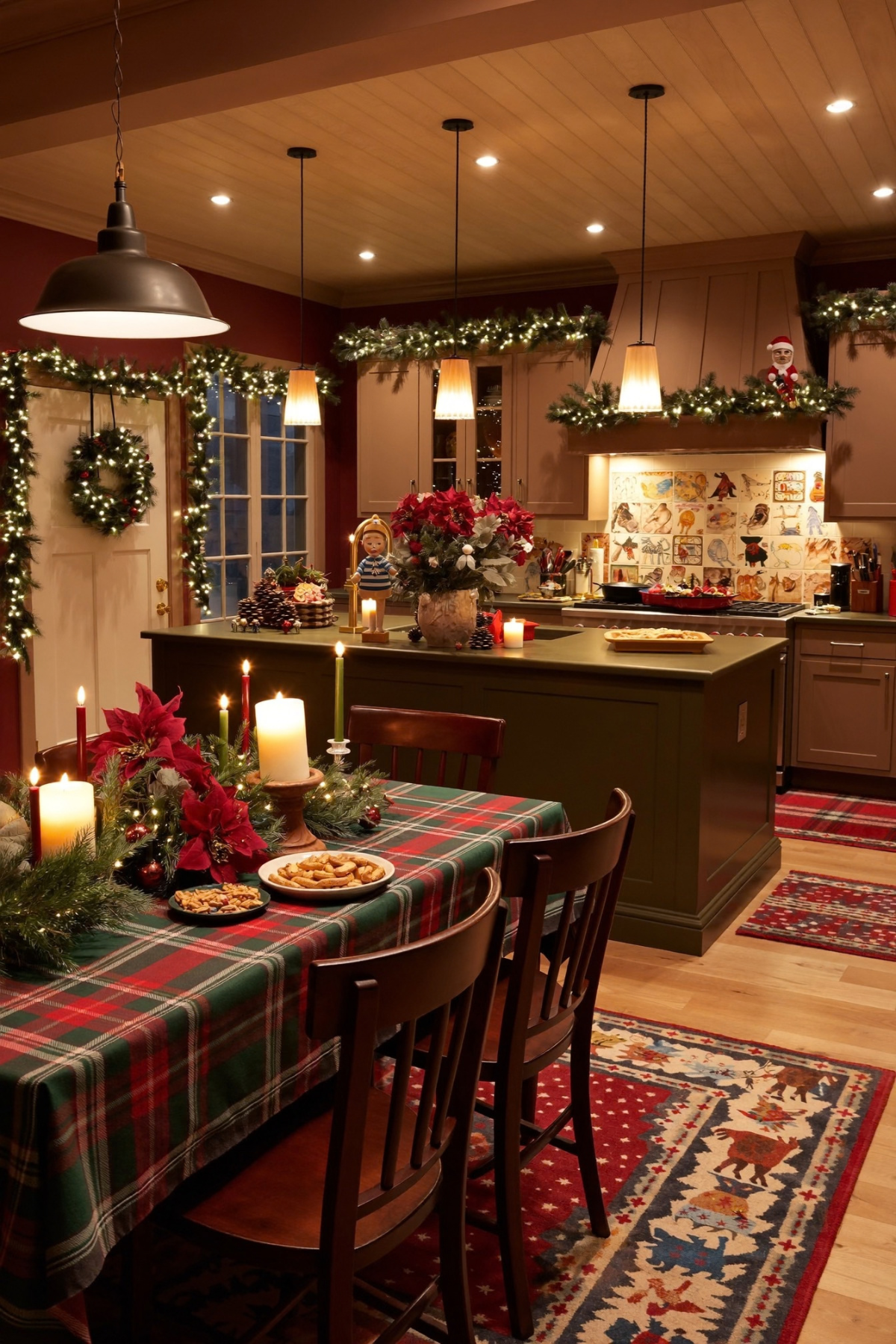
Pick a pattern, and use it more than once. This kitchen wraps the same tartan around curtains, the island skirt, and the dining table, which is exactly why it reads as one cohesive room instead of three separate decorating decisions stitched together. Repetition, not variety, is what ties a space like this together.
An island skirt is a trick more people should try. Sewing or clipping a length of fabric around the base of an island hides open shelving or storage underneath while adding texture at floor level, somewhere most kitchens have zero visual interest during the holidays.
Garland strung along the top of the cabinets, right where wall meets ceiling, does something a wreath alone can’t: it pulls your eye around the entire perimeter of the room instead of stopping at one focal point. Run it continuously along every run of upper cabinets rather than breaking it into separate pieces, and let the wreath on the hood be the one spot where it clusters into something denser.
Work With The Kitchen You Have
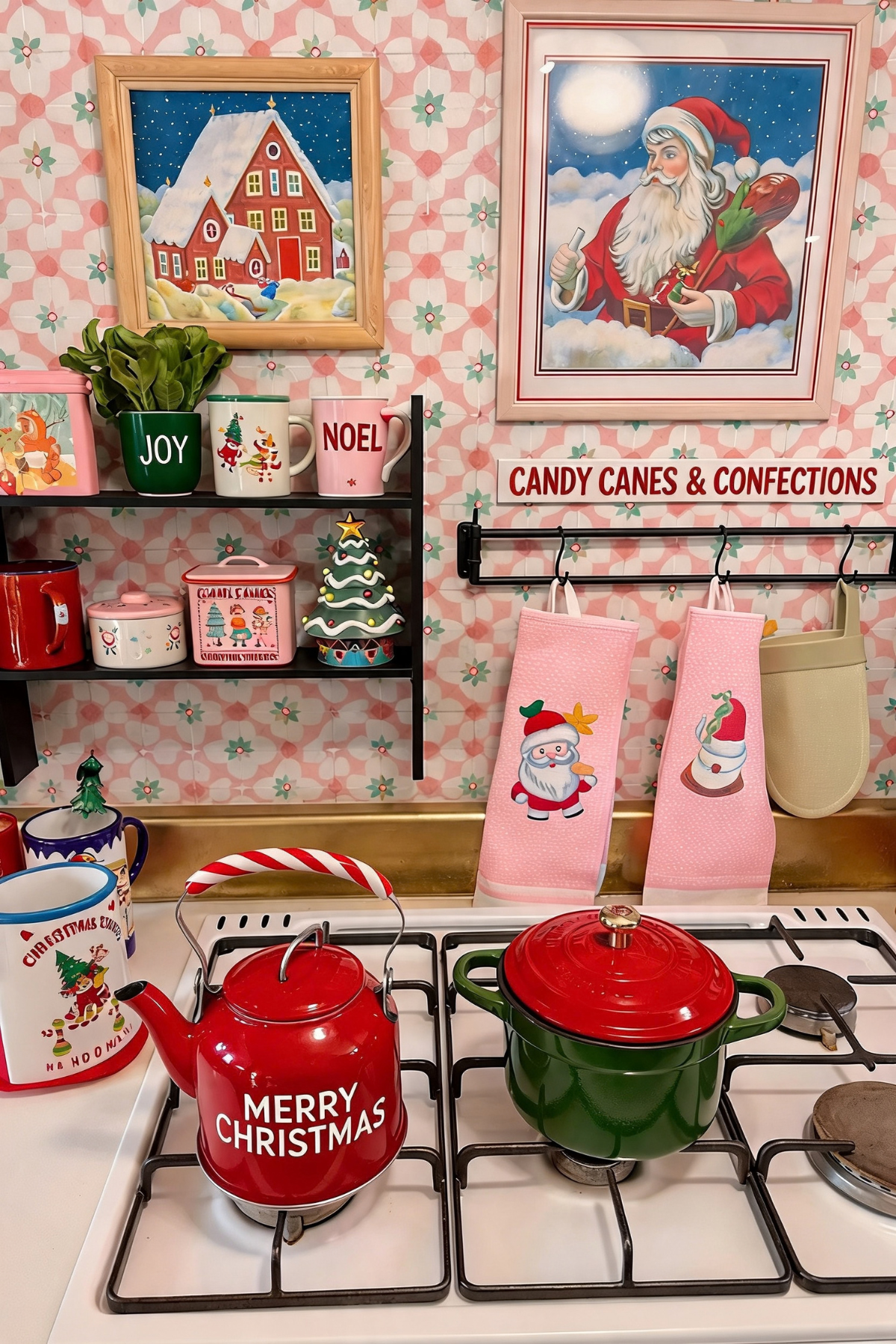
Not everyone has a neutral kitchen to layer Christmas onto, and this one proves you don’t need to fight your existing colors to make the season show up. Bright pink tile stays exactly as it is, and the red kettle and green pot just sit on top of it, playful rather than clashing.
A candy cane striped handle on an otherwise plain kettle is such a small swap, and it’s the kind of detail people notice without being able to say exactly why the kitchen feels festive. Small functional objects, the things you actually touch every day like handles, towels, and oven mitts, are an easy entry point if you’re not ready to commit to a full room overhaul.
Signage only works when it matches the room’s sense of humor, and a sign like Candy Canes and Confections next to actual cookware sells the whole bit. Framed vintage-style prints of santa and gingerbread houses lean into nostalgia rather than trying to look expensive, which fits a kitchen already this unapologetically colorful.
Decorate The Seats Nobody Thinks About
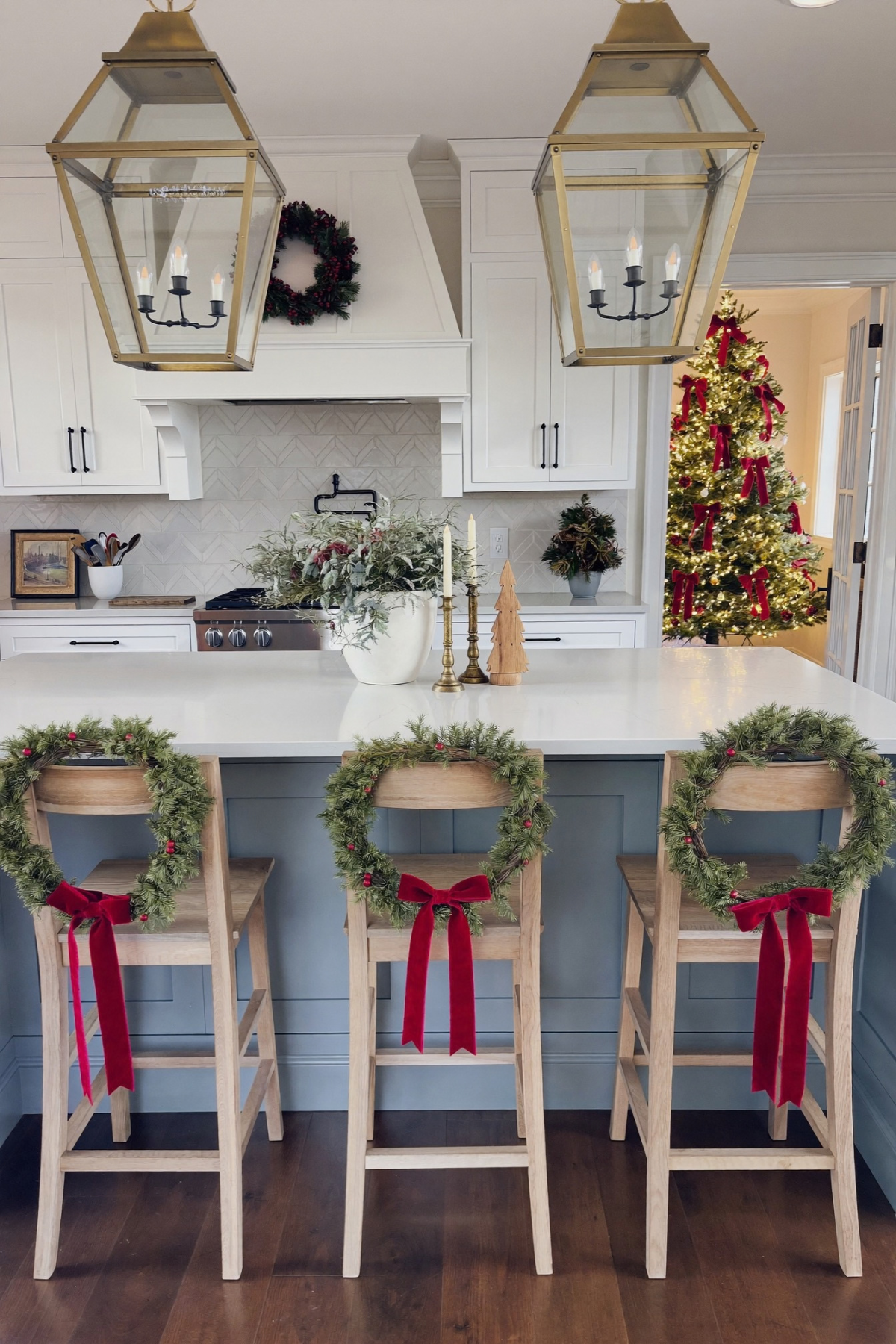
Bar stools sit at eye level for anyone in the kitchen, and yet they’re one of the last places most people think to decorate. Small wreaths tied to the back of each stool with a long red velvet ribbon change the whole feel of an island seating area for the cost of three mini wreaths and some ribbon.
Restraint is really the design lesson here. Beyond the stool wreaths, the room sticks to one wreath on the hood, a loose arrangement of greenery on the counter, and a pair of candlesticks. Nothing competes with the brass lantern pendants overhead, which get to stay the most dramatic thing in the room precisely because everything else stays quiet.
If you’re working with a smaller budget or less time, this is the idea to steal first. Buy three or four small wreaths meant for a front door and repurpose them entirely on furniture instead, tying them with ribbon in a color that already exists somewhere else in your kitchen so it doesn’t read as an afterthought.
Let Signage Carry Some Personality
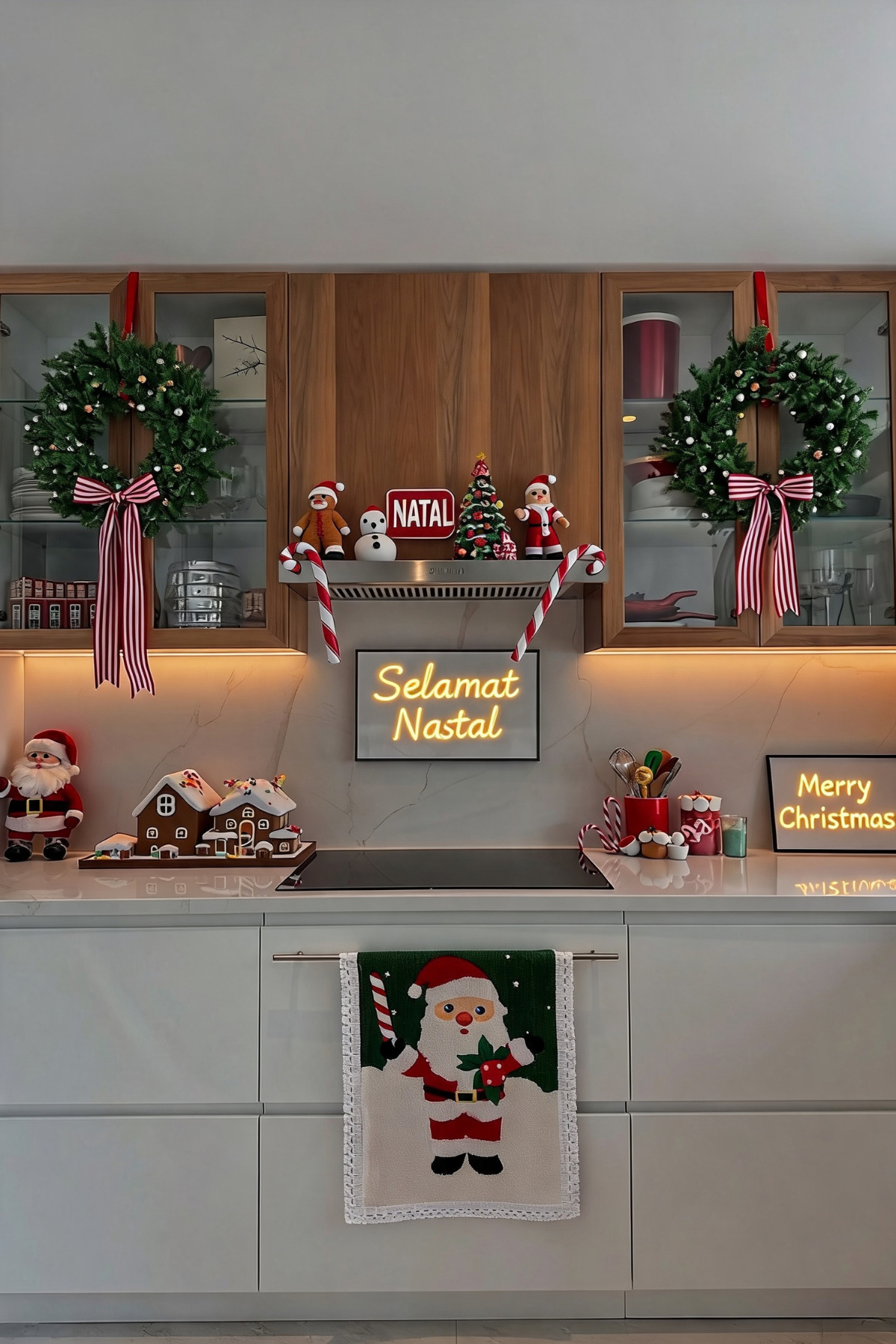
Neon signs have moved well past bar decor and into regular home use, and a kitchen is actually a smart place for one, it’s a room people linger in, unlike a hallway they walk straight through. Choosing wording that reflects your own language or background, rather than a generic Merry Christmas, is what makes a sign like this feel personal instead of purchased off a shelf.
Symmetry does a lot of the visual organizing in this kitchen. A wreath hangs on each glass cabinet flanking the range hood, tied with the same striped ribbon, and that mirrored placement is what keeps a busy collection of gingerbread houses, candy canes, and figurines from feeling scattered.
Candy canes draped over the front of a range hood are an easy detail to copy, and they cost almost nothing. Two oversized candy canes hooked over the hood edge fill dead space above the stove that usually goes completely undecorated. A knit towel with a santa motif on the cabinet below finishes the corner without adding another surface to style.
Decorate Around Your Gallery Wall
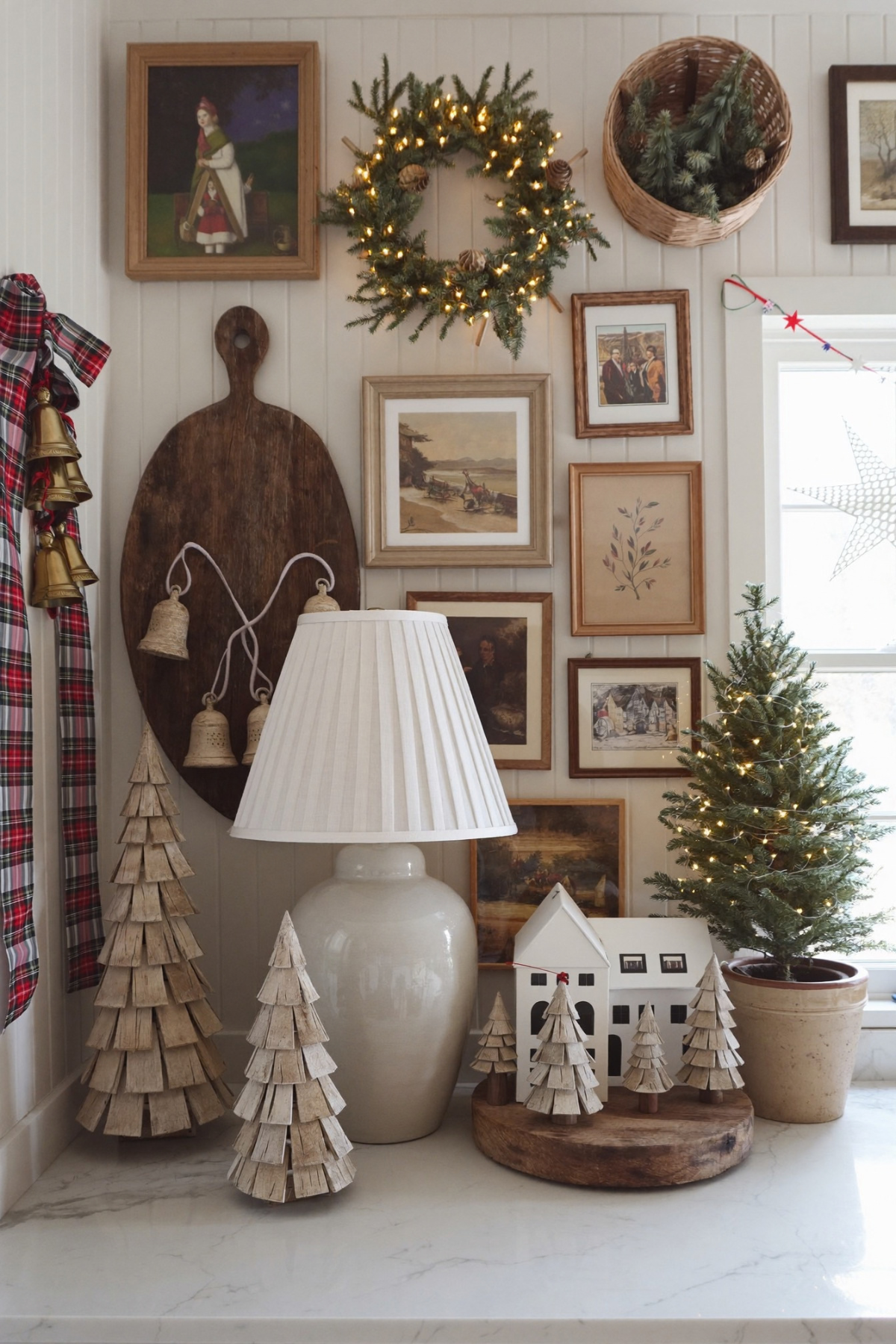
A gallery wall you’ve spent years assembling doesn’t need to come down for the holidays, it just needs a few seasonal pieces woven in around it. A lit wreath slots in between the frames here as though it always belonged there, and a basket of real greenery tucked on a shelf above does the same job without a single nail.
On the counter below, the trick is mixing textures rather than matching them. Wooden shingle trees, a ceramic lamp, a white paper house, and a small potted tree in a terra cotta pot all sit together, and it works because no two objects share the same material. Group items in odd numbers, three trees rather than two or four, and the arrangement reads as deliberate instead of random.
Vintage bells hung from an old wooden cutting board are the kind of detail that only works because it’s slightly unexpected. Keep an eye out at flea markets or in a box of old kitchen tools for objects that weren’t made for Christmas but can be pressed into service anyway, they tend to feel more original than anything bought specifically for the season.
Take Christmas Beyond Red And Green
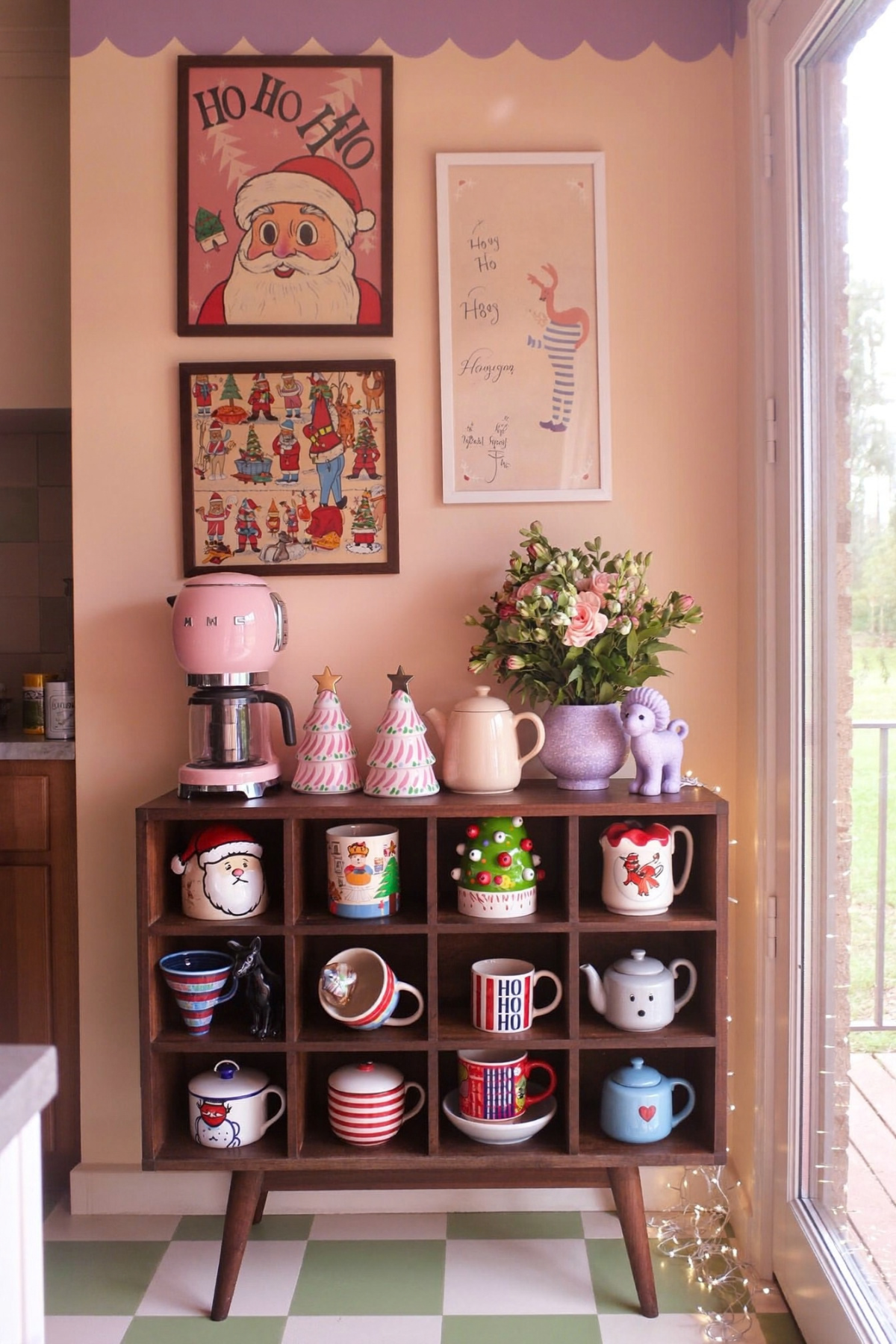
Pink, lavender, and soft green make an unusual case for a Christmas palette, and this nook is proof it works if you commit to it fully rather than sprinkling it in. A pastel coffee maker, ceramic trees in blush pink, and a checkerboard floor in muted green all agree with each other instead of fighting the traditional red and green playbook.
A cubby shelf turns a mug collection into the main event of the room. Twelve small compartments, each holding one mug, teapot, or small figurine, works because every piece gets its own frame rather than being crowded onto a single shelf where nothing stands out on its own.
Framed vintage-style santa prints on a soft, unexpected wall color do more to set a mood than any single ornament could, so spend your budget there before you spend it on smaller decor. A loose bouquet of pink roses on top of the cabinet softens all those hard edges and keeps the whole corner from feeling like a themed display rather than a real kitchen.
This Is The Season Worth Cooking Through Together
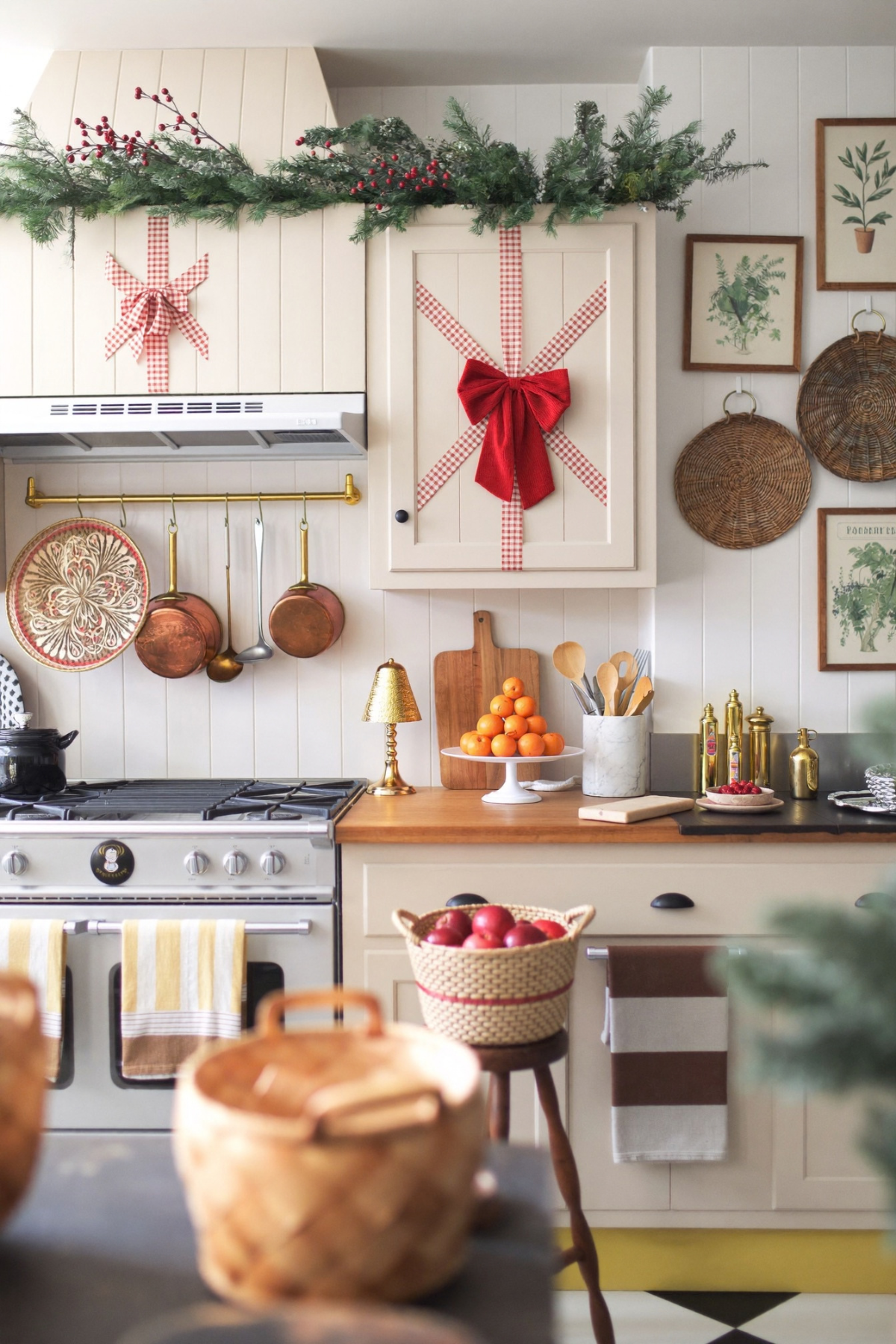
None of these kitchens got there with a single trip to one store. Most of what makes a space feel this warm is collected slowly, a set of mugs one year, a wreath on sale the next, a strand of lights that finally gets hung somewhere better than the box it came from.
Start with the surface you actually stand at most, whether that’s the stove, the island, or one open shelf, and build outward from there instead of trying to touch every corner of the kitchen at once. A room doesn’t need to be fully decorated to feel like the holidays have arrived in it.
Whatever direction you take it, red and plaid or pink and pastel, candlelit and quiet or dessert table and loud, the goal stays the same: a kitchen people actually want to stand in a little longer than usual, coffee in hand, in no rush to leave.